Political Science 4328
Dr. Arnold Leder
with the assistance of Delaina Toothman
The online version of this syllabus can be accessed @ http://www.arnoldleder.com/4328.htm
Password protected materials for this course can be viewed @ http://www.arnoldleder.com/readings/index.html. Scroll to the section on "The Holocaust/Shoah". Password and user name for access will be provided to students in the course.
For links to web syllabi for other courses taught by Dr. Leder see: http://www.arnoldleder.com/.
Political Science 4328 & Course Group Distribution Requirements in Political Science
For students who wish to use this course to meet Course Group Distribution requirements in Political Science, this course satisfies Group I- Political Theory and Methodology requirements. (This course may also be used to satisfy Group IV- Comparative Government requirements.) Political Science 4328 is designated a writing intensive (WI) course. For a list of undergraduate courses in Political Science by group, see: http://www.polisci.txstate.edu/courses/undergrad-courses.html.
Department Of Political Science/Texas State University http://www.polisci.txstate.edu/
UAC/Undergraduate Academic Center 355; Telephone number: (512) 245-2143; Fax number: (512) 245-7815
Liberal Arts Computer Lab: UAC/Undergraduate Academic Center 440; Website: http://www.polisci.txstate.edu/resources/computer-lab.htm
Office: UAC 363
Office Hours: MWF 8:00-8:50 a.m. & by appointment.
Texas State University Academic Calendar
Texas State University Final Exam Schedule
Selected Web Resources For Texas State University
Texas State University Library
Locating Periodicals @ Texas State University Library
Web Resources For The Shoah/Holocaust-Links To Many Websites
Including: Yad Vashem @ http://www.yadvashem.org/
United States Holocaust Memorial Museum @ http://www.ushmm.org/
The Jewish Virtual Library/The Holocaust http://www.jewishvirtuallibrary .org/jsource/holo.html
------------------------------------------
OVERVIEW OF COURSE
Course Title:
THE SHOAH (THE HOLOCAUST)
Documentary Film on the history of anti-Semitism:
European Antisemitism from Its Origins to the
Holocaust" (13 minutes) United States Holocaust Memorial
Museum @ https://www.ushmm.org/confront-antisemitism/european-antisemitism-from-its-origins-to-the-holocaust
An introduction to the history of
antisemitism from the days of the early Christian church until
the era of the Holocaust in the mid-20th century.
Holocaust Denial
https://www.ushmm.org/confront-antisemitism/holocaust-denial-and-distortion
(video - 2 minutes 57 seconds) United States Holocaust Memorial
Museum
Marion Samuel an eleven-year-old girl murdered in Auschwitz in 1943.
See: A review of: Götz Aly/Into the Tunnel: The Brief Life of Marion Samuel, 1931-1943 (Metropolitan Books/Henry Holt 2008).
From the Book Description at amazon.com:
A generous feat of biographical sleuthing by an acclaimed historian rescues one child victim of the Holocaust from oblivion When the German Remembrance Foundation established a prize to commemorate the million Jewish children murdered during the Holocaust, it was deliberately named after a victim about whom nothing was known except her age and the date of her deportation: Marion Samuel, an eleven-year-old girl killed in Auschwitz in 1943. Sixty years after her death, when Gtz Aly received the award, he was moved to find out whatever he could about Marion's short life and restore this child to history. In what is as much a detective story as a historical reconstruction, Aly, praised for his 'formidable research skills' (Christopher Browning), traces the Samuel family's agonizing decline from shop owners to forced laborers to deportees. Against all odds, Aly manages to recover expropriation records, family photographs, and even a trace of Marion's voice in the premonition she confided to a school friend: 'People disappear,' she said, 'into the tunnel.' A gripping account of a family caught in the tightening grip of persecution, Into the Tunnel is a powerful reminder that the millions of Nazi victims were also, each one, an individual life. (boldface added)
"This is a weighty little book, as easy to read as it is difficult to forget... For Marion Samuel, the future was a brief life and a brutal end, followed by years of obscurity...Götz Aly has accomplished a remarkable feat: he has vividly conjured up and restored to history the beginning of a life that was not to be. If only this work of commemoration could be done for all those who disappeared into the tunnel." (boldface added) — from the preface by Ruth Kluger, author of Still Alive: A Holocaust Girlhood Remembered.
See: http://www.ushmm.org/research/publications/academic-publications/full-list-of-academic-publications/into-the-tunnel-the-brief-life-of-marion-samuel-19311943
___________________________________________________________________________________
Topics
I. The Shoah (The Holocaust): Terms, Thoughts, & Images
II. SurvivingThe Shoah
III. German Perpetrators And Jewish Victims
IV. Polish Perpetrators And Jewish Victims
V. Why Bulgaria's Jews Survived
VI. Anti-Semitism In Germany
VII. The War Against The Jews
VIII. Ordinary Germans & The Holocaust (Police Battalion 101 And Others)
IX. Goldhagen & His Critics & Defenders
X. Representing The Shoah (The Holocaust)
XI. Anti-Semitism Past & Present
-------------------------------------------------------------------------------------------------------------------------------
COURSE ORGANIZATION & STUDENT RESPONSIBILITIES
A seminar devoted to intensive reading and writing about and discussion of The Shoah (The Holocaust). Topics covered include: Efforts to Understand The Holocaust; The Evolution of anti-Semitism in Germany; The War Against the Jews; Ordinary Germans and the Holocaust; Ordinary Poles and The Holocaust; Representing The Holocaust in fiction, film, and poetry; and post Holocaust "New anti-Semitism".
PURPOSE OF THE
COURSE
The purpose of this course is to provide
a basis for examination of several critical dimensions of
The Holocaust. These dimensions include: the views,
motivations, and actions of the murderers; the experiences
of Jewish victims; Anti-Semitism; alternative explanations
of the causes and nature of The Shoah and the challenge to
scholarship; the issue of remembering The Holocaust; and
the significance of the "New Anti-Semitism".
Class Participation, Oral
Presentations, Exams, Papers, Grades
1. This course will be conducted as a
seminar. Students should plan to attend every class
meeting and be prepared to discuss assigned readings and
other materials. Active participation in class
discussion is essential. Course grades will be
determined by oral presentations, class participation,
exams, and written papers.
2. Determinants of Course Grade: Oral
Reports & Presentations 25%/ Seminar Participation
15%/ Essay Exams/Papers 60%
Attendance
1. Two (2) unexcused absences
are permitted. Students with three (3) unexcused
absences may have their course grade
lowered. Students who have four (4) unexcused
absences should consider withdrawing from the course.
2. The instructor for the course is not
responsible for bringing students who have missed class
"up-to-date" on missed material. Each student has
the responsibility to remain current with respect to class
material.
Students
with Disabilities:
Qualified students with disabilities are entitled to
reasonable and appropriate accommodations in accordance with
federal laws including Section 504 of the 1973 Rehabilitation
Act and the 1990 Americans with Disabilities Act, and the
university policy UPPS 07.11.01. Students with special needs
(as documented by the Office of Disability Services) should
identify themselves at the beginning of the semester.
For an excerpt from this statement see the end of this syllabus.
-----------------------------------------------------------------------------------------
COURSE CONTENT
Note On Course & Syllabus Materials: Students may find books, articles, links, websites, and other materials provided in this syllabus useful and of interest. Their listing in this syllabus, including those which are required and recommended, does not necessarily indicate endorsement of or agreement with any views or positions on any issues found in these materials, websites, or on other sites to which they may provide links.
- Aharon Appelfeld/Badenheim 1939 (D. R. Godine Publishers 1995) [Hebrew original published in 1975]
- Christopher Browning/Ordinary Men: Reserve Police Battalion 101 and the Final Solution in Poland (1993) [with a new Afterword]
- Inga Clendinnen/Reading The Holocaust (Cambridge University Press 1999)
- Daniel Goldhagen/Hitler's Willing Executioners (Knopf 1996/Vintage 1997)
- Jan T. Gross/Neighbors: The Destruction Of The Jewish Community In Jedwabne, Poland (Princeton University Press 2001)
- Primo Levi/Survival In Auschwitz(Collier1993)[Original Italian edition published in 1947]
- Yosefa Loshitzky (ed.)/Spielberg's Holocaust: Critical Perspectives On Schindler's List (Indiana University Press 1997)
- Robert R.Shandley (ed.)/Unwilling Germans? The Goldhagen Debate (University Of Minnesota Press 1998)
Recommended Books
Omer Bartov/The "Jew" In Cinema: From The Golem To Don't Touch My Holocaust (Indiana University Press 2005)
Christopher Browning/The Origins Of The Final Solution: The Evolution of Nazi Jewish Policy, September 1939-March 1942/Garners Books 2005 (Original hard cover Univ. Of Nebraska Press & Yad Vashem 2004)
Emil L. Fackenheim/To Mend The World (Indiana University Press 1982)
Robert Gellately/Backing Hitler: Consent And Coercion In Naz iGermany (Oxford University Press Paperback 2002)
Jan Gross/Fear: Anti-Semitism in Poland After Auschwitz(Random House 2006)
Bernard Harrison/The Resurgence Of Anti-Semitism: Jews, Israel, And Liberal Opinion (Rowman & Littlefield 2006)
Jeffrey Herf/The Jewish Enemy: Nazi Propaganda During World War II And The Holocaust (Belknap-Harvard University Press 2006)
Anthony Julius/Trials of the Diaspora: A History of Anti-Semitism in England (Oxford University Press 2010)
Ilona Karmel/An Estate Of Memory(The Feminist Press City University of New York 1969)
Imre K ertész/Fatelessness (Vintage 2004)
Victor Klemperer/I Will Bear Witness 1933-1941:A Diary Of The Nazi Years (Modern Library Paperback 1999)
Victor Klemperer/I Will Bear Witness 1942-1945:A Diary Of The Nazi Years (Modern Library Paperback 2001)
Walter Laqueur/The Changing Face of Anti-Semitism: From Ancient Times to the Present Day (Oxford University Press 2006)
Peter Longerich/Holocaust: The Nazi Persecution and Murder of the Jews (Oxford Univerity Press, 2010)
Kristen R. Monroe/The Hand Of Compassion: Portraits of Moral Choice During the Holocaust (Princeton University Press 2004)
Antony Polonsky & J.B. Michlic (eds.)/The Neighbors Respond:The Controversy Over The Jewadnebe Massacre In Poland (Princeton Univ. Paperback 2004)
TzvetanTodorov/The Fragility Of Goodness:Why Bulgaria's Jews Survived The Holocaust (Princeton University Paperback 2001)
Alan E. Steinweis/Studying the Jew: Scholarly Anti-Semitism in Nazi Germany (Harvard University Press 2006)
Robert S. Wistrich/A Lethal Obsession: Anti-Semitism from Antiquity to the Global Jihad (Random House 2010) - [Click on "Read an Excerpt" for pp 79 - 85 of Chapter One From Decide to Genocide]
Required Articles:
These are listed in each section of the syllabus. Access to articles through the Texas State University Library, available to all Texas State University students, requires a valid User Name and a Password. Many of the links in this syllabus provide direct access to the article.
Films:
A Film Unfinished (2010) [1hr. & 29 min.]
English, Hebrew, German, Polish and Yiddish, with English subtitles.
For a review of this film, see: Jeannette Catsoulis/An Israeli Finds New Meanings in a Nazi Film/NYT, August 17, 2010.
The Israeli director Yael Hersonski embarks on a critical analysis of a Nazi propaganda film about the Warsaw Ghetto.
America And The Holocaust (1994) [1hr. & 30 min.]
From the Public Broadcasting Service (PBS) series, "The American Experience" @ America And The Holocaust (Video)/pbs.org/wgbh/amex/holocaust/
Der Ewige Jude (The Eternal Jew) [1940 70 min.] (Google videoplay - English dubbing)
See paper by Stig Hornshoj-Moller (with links & photos)
" 'Der Ewige Jude' ('The Eternal Jew') is the most famous Nazi propaganda film. It was produced at the insistence of Joseph Goebbels, under such active supervision that it is effectively his work. It depicts the Jews of Poland as corrupt, filthy, lazy, ugly, and perverse: they are an alien people which have taken over the world through their control of banking and commerce, yet which still live like animals."
See also: Photos Link: Nazi Propaganda Film Classic"The Eternal Jew"(Der-Ewige-Jude)/Still Photos
"the Jew as the agent of destruction" - See: Omer Bartov/The "Jew" In Cinema: From The Golem To Don't Touch My Holocaust (Indiana University Press 2005), p. 8.
and
Jud Süss (Jew Suess) [1940 1hr. 35min. Germany w/ English subtitles - restored dvd 2008]
Jud Süss The most successful anti-Semitic film the Nazi's ever made.
"... its central theme is the pollution of German blood" (p. 9 of Omer Bartov/The "Jew" In Cinema); "[Jew Suess] successfully introduced the main features of the anti-semitic view of the Jew to millions of Germans and other Europeans." (p. 13 of Omer Bartov/The "Jew" In Cinema).
For an examination of the Nazi regime's use of propaganda films, see: Katie Trumpener, "Drowning out the Newsreel", London Review of Books, 12 March 2009. This article can be viewed @ http://www.arnoldleder.com/readings/index.html. Scroll to the section on "The Holocaust/Shoah" and look for the author and title of this article. This location is password protected. Password and user name for access will be provided to students in the course.
For a backgrounder on Jud Süss, see: http://www.holocaustresearchproject.org/holoprelude/judsuss.html.
Fateless (2006) [2
hrs. & 20 min./Hungarian, German, with English
subtities]
This film is based on the Nobel Prize winner Imre Kertész's
novel, Fatelessness
(Vintage 2004), about a young Jewish boy's deportation
in 1944 from Budapest, his struggle to survive in the
concentration camps, and his perceptions and feelings when he
returns home. (Hungarian and German with English
subtitles.)
"Set in 1944, as Hitler's Final Solution becomes policy
throughout Europe, Fateless is the semi-autobiographical tale
of a 14 year-old Jewish boy from Budapest, who finds himself
swept up by cataclysmic events beyond his comprehension. A
perfectly normal metropolitan teen who has never felt
particularly connected to his religion, he is suddenly
separated from his family as part of the rushed and random
deportation of his city's large Jewish population. Brought to
a concentration camp, his existence becomes a surreal
adventure in adversity and adaptation, and he is never quite
sure if he is the victim of his captors, or of an absurd
destiny that metes out salvation and suffering arbitrarily.
When he returns home after the liberation, he missed the sense
of community he experienced in the camps, feeling alienated
from both his Christian neighbors who turned a blind eye to
his fate, and the Jewish family friends who avoided
deportation and who now want to put the war behind
them." From: the dvd cover for the film.
This video is a production of C-SPAN based on an original television broadcast by ZDF, a major German TV network. The video is stored at Purdue University Public Affairs Archives.] It records a public discussion of Daniel Goldhagen's book, Hitler's Willing Executioners , with Daniel Goldhagen responding to a number of his German critics held before a German audience. This video is now available in dvd format.
From the c-span archives: "During the German promotion tour for his new book, Hitler's Willing Executioners, Mr. Goldhagen participated in a panel discussion with German historians, a Holocaust survivor and a German World War II veteran sponsored by German television in Aschaffenburg, Germany. The debate focused on his arguments about the role of ordinary Germans from virtually all backgrounds in the murder of Jews and the character and intensity of German anti-Semitism. He also took a few questions and comments from the audience. Translation of all remarks but Goldhagen's from German to English was by voiceover".
The Grey Zone
(2001) [1hr. & 48 min.]
Based on real life events, this film
depicts a unit of Auschwitz's Sonderkommando, special
squads of Jewish prisoners who worked in the death camps.
"The Grey Zone, a most
unenchanting depiction of the grisly experiences of the
Sonderkommandos, the Jews who were forced to burn the bodies
in Auschwitz, failed miserably at the box office when it was
released in 2002, and closed in many theaters within days.
There was nothing uplifting about this film; no Jews who were
saved in it, no children of survivors who, in living color,
marched past the grave of the man who had saved their parents,
and no fable about a man’s love for his son. This film wasn’t
without its flaws; but a large audience would have learned
something true about the Holocaust had it not been scared off
by reports of the film’s graphic honesty. That honesty was
made clear in a review in the New York Times, in
which the reviewer concluded that The Grey Zone was
an honorable film. 'But honorable,' the reviewer warned, 'is
not always watchable.'[11] And, in the end, it turned out that
almost no one watched."
From: Walter
Reich/The Use and Abuse of Holocaust Memory November 14,
2005 @ http://www.aei.org/speech/23492
"The Grey Zone is nevertheless
one
of the most honest representations of Jewish heroism in the
Holocaust - the greatest heroism of all, that of transforming
oneself from slave to rebel, from beast to man, ..."
From: Omer Bartov/The "Jew"
In Cinema: From The Golem To Don't Touch My Holocaust
(Indiana University Press 2005), p. 147.
Image
Before
My Eyes-A History of Jewish Life in Poland Before The
Holocaust (1981) [88 min./dvd release date April 2006]
"A stunning commemoration of Jews in Poland before the two
World Wars IMAGE BEFORE MY EYES pays homage to the dynamic and
vibrant society of 3.5 million people that was destroyed
during the Holocaust.Unearthing the stories of Jewish
villagers aristocrats socialists Zionists and artists who
fashioned a thriving civilization with a 900-year history this
triumphant films draws on the sacred and rare artifacts of a
crushed world-home movies forgotten song recordings and the
evocative memories of survivors-to recreate Jewish Poland.
Tracing the subtle contours of Jewish Diaspora IMAGE BEFORE MY
EYES visits people as varied as a former mayor of Scarsdale
New York describing his youthful Polish patriotism and a
Brooklyn housewife who touchingly sings the Yiddish songs of
teachers tradesmen and beggars she learned as a child in
Warsaw.From the bucolic traditional shtetls of the countryside
to the freewheeling cultural revolution in the cities led by
freethinkers award-winning director Josh Waletzky (Partisans
of Vilna) masterfully memorializes a proud culture that still
inspires hope and reverence". Review posted @
amazon.com.
See also this description of this documentary film, Image Before My Eyes,
provided by YIVO, Institute for Jewish Research, @ http://www.yivoinstitute.org/index.php?tid=106&aid=347.
In addition, see the review below by Julia Hirsch Schwartz of
the book Lucjan
Dobroszycki,
Barbara Kirshenblatt-Gimblett/Image Before My Eyes: A
Photographic History of Jewish Life in Poland (1977 - paper
reprint by Schocken in 1994): Julia
Hirsch
Schwartz, Image
Before
My Eyes: A Photographic History of Jewish Life in Poland,
1864-1939, Jewish Social Studies, Winter 1979,
Vol. 41, Issue 1, pp. 90-91, 2 pages. (pdf)
Texas State University permalink. A valid Texas State
University User Name and password are required for access.
For backgound information on the Jews of Poland, see:
Rebecca Weiner, "The Virtual Jewish History Tour: Poland" @ http://www.jewishvirtuallibrary.org/jsource/vjw/Poland.html.
A documentary which uses rare film footage, archival photos, and interviews with former residents to re-create the fabric of daily life in the predominantly Jewish market town, or shtetl, of Luboml in prewar Poland. The video reveals Luboml as a vibrant town where religious tradition and community life coexisted. No quaint rural village, Luboml was an important regional market town, complete with theater, a cinema, electric lights, sports teams, numerous trades and businesses, and factories and workshops. In 1941-1942, German forces destroyed Luboml's Jewish community and murdered nearly all of its Jewish citizens.
For backgound information on the Jews of Poland, see: Rebecca Weiner, "The Virtual Jewish History Tour: Poland" @ http://www.jewishvirtuallibrary.org/jsource/vjw/Poland.html.
Memory Of The Camps/PBS - Frontline 60 min. (2005 DVD release w/backgrounder & resources links; original film footage 1940; first shown on PBS 1985)
"For more than thirty years this film of the Nazi death camps had been stored in a vault of the Imperial War Museum, London. Today it is recognized as one of the most definitive and unforgettable records of the 20th century's darkest hour."
...
"Sixty years ago, in the spring of 1945, Allied forces liberating Europe found evidence of atrocities which have tortured the world's conscience ever since. As the troops entered the German concentration camps, they made a systematic film record of what they saw. Work began in the summer of 1945 on the documentary, but the film was left unfinished. FRONTLINE found it stored in a vault of London's Imperial War Museum and, in 1985, broadcast it for the first time using the title the Imperial War Museum gave it, Memory of the Camps." (May 3, 2005).
Night And Fog
(1955) [32 min./French with English subtitles]
"[Night
And Fog] turns all the victims of Nazism into
heroes of the Resistance, thereby using heroism as a means
to incorporate the genocide of the Jews into the larger
tale of European sacrifice, and burying the singular
memory of the Shoah under a rhetorical mountain of
generalized sorrow and official bombast".
From: Omer Bartov/The "Jew"
In Cinema: From The Golem To Don't Touch My Holocaust
(Indiana University Press 2005), p. 178.
The Quarrel (1990)
[1hr. 30 min.]
"Montreal 1948. On Rosh Hashanah, Chaim (a Yiddish writer) is
forced to think of his religion when he's asked to be the
tenth in a minyan. As he sits in the park, he suddenly sees an
old friend whom he hasn't seen since they quarrelled when they
were yeshiva students together. Hersh, a rabbi, survived
Auschwitz and his faith was strengthened by his ordeal, while
Chaim escaped the Nazis, but had lost his faith long before.
The two walk together, reminisce, and argue passionately about
themselves, their actions, their lives, their religion, their
old quarrel, and their friendship." From amazon.com -
synopsis of the film.
The Round Up/La Rafle
[original French title of film] (2010/French with
English subtitles 2hrs, 5min.)
"In the early hours of July 17th, 1942, more than
13,000 Jews were taken from their homes in occupied Paris and
detained at the Velodrome d’Hiver. They were held there for a
few days before being shipped off to a holding site, and
finally to the concentration camps, of which only 25 survived.
The military force that undertook this disgusting act was not
German. No, the men who so enthusiastically enforced the act
of cleaning the Jews from Paris were French."
From: Movie
Review: The Round-Up (2010) Colin Harris, October 11, 2010 @ http://thecriticalcritics.com/review/2010/10/11/movie_review-the_round-up.html
Official website for the film (in French): http://www.larafle-lefilm.com/
See: http://en.wikipedia.org/wiki/The_Round_Up_(film)
http://www.imdb.com/title/tt1382725/officialsites
Shoah (1985)
[9hrs. & 23 min.] (Portions
of
this film will be shown in class.)
Widely regarded as a masterpiece and the classic
documentary film on The Holocaust.
From the review @ amazon.com
"To write a review of a film such as Shoah seems an impossible
task: how to sum up one of the most powerful discourses on
film in such a way as to make people realize that this is a
documentary of immense consequence, a documentary that is not
easy to watch but important to watch, a documentary that not
only records the facts, but bears witness. We are commanded
"Never forget"; this film helps us to fulfill that mandate,
reverberating with the viewer long after the movie has ended.
Yes, Holocaust films are plentiful, both fictional and non-,
with titles such as The Last Days, Schindler's List, and Life
Is Beautiful entering the mainstream. But this is not a film
about the Holocaust per se; this is a film about people. It's
a meandering, nine-and-a-half-hour film that never shows
graphic pictures or delves into the political aspects of what
happened in Europe in the 1930s and '40s, but talks with
survivors, with SS men, with those who witnessed the
extermination of 6 million Jews.
Omer Bartov on Shoah:
"Lanzmann [in his film Shoah] allows the victims to become human again by interviewing them several decades after the event. Lanzmann allows the victims to speak about their unique, individual fates, and thereby he rescues them from being mere representatives of the 'Jew'." (Omer Bartov/The "Jew" In Cinema, p. 49.)
"... in Lanzmann's film [Shoah] each witness is given a face, an individual experience, and reflects what happened only through his or her own account, without juxtaposing these accounts with the distorted images, produced by the Nazis; they exist as human beings rather than as an accusative choir. In this manner they escape from History (with a capital 'H') and reconstruct their own very personal history, which is the true fabric of the human experience." (Omer Bartov/The "Jew" In Cinema, p. 57.)
Schindler's List
(1993) [3 hrs. & 17 min.]
The Holocaust film which likely has been
viewed by more people than any other Holocaust film.
Son of Saul
(2015 Release -
1hr. & 47 minutes )
A 2015 Hungarian drama
film set in the Auschwitz concentration
camp during World War II, and follows a
day-and-a-half in the life of Saul Ausländer a Hungarian
member of the Sonderkommando. Trailer @
https://www.youtube.com/watch?v=sWQTfbXLTH
Triumph
Of The Will (1934 1hr. & 50 min.) [youtube
- German with English subtitles]
A Nazi
propaganda classic directed by the infamous Leni
Riefenstahl.
The Wannsee
Conference (1984) [1hr. & 27 min./German with
English subtitles]
View film @ https://www.youtube.com/watch?v=3ave9RHTqkI
A German "docudrama"
portraying the historic Wannsee Conference (January 20,
1942) of high ranking German officials and their
discussion of the extermination of Europe's Jews. On
January 20, 1942 one of the most macabre conferences in
history took place at an idyllic lakeside house Am Großen
Wannsee 56/58 in Wannsee near Berlin. The subject was the
organisation of the 'Final Solution', the destruction of
all 11 million European Jews. In the relaxed and
distinctively upper middle-class atmosphere of that SS
guest-house fifteen highly placed German officials met and
discussed the best strategy for genocide, over a glass of
good cognac.
Aftermath (2013) [1hr. & 40 min.] Polish with English subtitles. This film was inspired by events described in
Jan T. Gross/Neighbors: The Destruction Of The Jewish Community In Jedwabne, Poland (Princeton University Press 2001)
For a description of this film and links to reviews, see: http://www.menemshafilms.com/aftermath.
A Secret (French w/English subtitles) 2009 [103 min.]
See: http://www.salon.com/ent/movies/btm/feature/2008/09/05/secret/ ("A Secret") & http://www.youtube.com/watch?v=hxmHroAUCZI (Trailer for "A Secret").
Jacob The Liar (1999) [2 hrs.]
Based on a novel by a German-Jewish author, this film tells the story of combatting depression in the Warsaw Ghetto through fictitious news bulletins, from a radio which does not exist, on Allied advances against the Germans.
One
Day
You'll Understand (French w/English subtitles) 2007-dvd
release 2009 [90 min.]
See: http://www.salon.com/ent/movies/btm/feature/2008/11/01/one_day/index.html
& http://www.youtube.com/watch?v=QES2hrUAhW4
(Trailer for "One Day You'll Understand").
The Pianist
(2002) [2 hrs. & 30 min.]
A story of a young
Jewish musician in Poland who survives the
Holocaust. Some reviewers have been critical,
suggesting the lead character's passivity and
helplessness conform to a European desire to see
Jews as weak and passive.
For a critical view of this film see: Michael B. Oren, "Schindler's Liszt",
The New Republic
, March 17, 2003, Vol. 228, Issue 10.
Texas State University
permalink. A valid Texas State University User Name
and password are required.
The passive Jew, the "good German", and the "good
Pole". See: Omer Bartov/The "Jew"
In Cinema: From The Golem To Don't Touch My Holocaust
(Indiana University Press 2005), p. 144.
For a review essay on films about The Holocaust/Shoah,
see: A.
O.
Scott/Never Forget. You're Reminded.(Review Essay on
Holocaust films w/stills from film scenes, trailers, &
links)/NYT Sunday Arts & Leisure Section, pp. 1& 13,
November 23, 2008.
See also: John
Podhoretz, "Why I Don't Watch
Holocaust Films", Mosaic, March
16, 2016 @ http://mosaicmagazine.com/response/2016/03/why-i-dont-watch-holocaust-movies/
___________________________________________
TOPICS FOR READING, SEMINAR PRESENTATION, & DISCUSSION
I. The Shoah (The Holocaust): Terms, Thoughts, & Images
1. On Use Of The Terms "Shoah" & "Holocaust"
"The biblical word Shoah (which has been used to mean "destruction" since the Middle Ages) became the standard Hebrew term for the murder of European Jewry as early as the early 1940s. The word Holocaust, which came into use in the 1950s as the corresponding term in English, originally meant a sacrifice burnt entirely on the altar. The selection of these two words with religious origins reflects recognition of the unprecedented nature and magnitude of the events. Many understand Holocaust as a general term for the crimes and horrors perpetrated by the Nazis; others go even farther and use it to encompass other acts of mass murder as well. Consequently, we consider it important to use the Hebrew word Shoah with regard to the murder of and persecution of European Jewry in other languages as well." (boldface added)
Source: http://www1.yadvashem.org/yv/en/holocaust/resource_center/the_holocaust.asp.
For a discussion of the terms Shoah and Holocaust, see: Philologus, "Best Way To Say the Unsayable", Forward August 31, 2001.
This article can be viewed @ http://www.arnoldleder.com/readings/index.html. Scroll to the section on "The Holocaust/Shoah" and look for the author, Philologus: Shoah and Holocaust. This location is password protected. Password and user name for access will be provided to students in the course.
"... there is no good and much harm, to be done by, in effect, redefining the term holocaust in such a way as to allow the concrete specificity of the Nazi genocide, and with it everything which links it to enduring aspects of European culture and politics, to fade from view. For that is what would happen if we were to allow ourselves to be led, through a persuasive reassignment of the descriptive content and reference of the term holocaust in the direction of greater generality, to imagine that every great evil done by human beings to one another ... is a phenomenon of exactly the same kind as the Nazi Holocaust. Everything is what it is and not another thing. Evil is not a single recurrent feature of human life, eternally self-identical in its nature. There are many kinds of evil, springing from many different causes ... If we are to think rationally about these matters, if our response to human evil is not to be reduced to futile and sentimental hand wringing, we need a vocabulary which allows us to keep track of the differences." (boldface added)
Bernard Harrison, The Resurgence Of Anti-Semitism: Jews, Israel, And Liberal Opinion (2006), pp. 125-126.
2. Images of The Shoah
Films/Videos:
Night And Fog
Memory Of The Camps
View the film "Memory Of The Camps" online @ http://www.pbs.org/video/frontline-memory-camps/
Readings (on the film "Night and Fog"):
Charles Krantz, "Teaching [the film] Night and Fog: History and Historiography", Film & History , February 1985, Vol. 15, Issue 1, pp. 2-15. @
https://muse-jhu-edu.libproxy.txstate.edu/journals/film_and_history/toc/flm.15.1.html
(pdf)
(Note: It is recommended that this article be read after viewing the film "Night and Fog".)
"[Night And Fog] turns all the victims of Nazism into heroes of the Resistance, thereby using heroism as a means to incorporate the genocide of the Jews into the larger tale of European sacrifice, and burying the singular memory of the Shoah under a rhetorical mountain of generalized sorrow and official bombast".
From: Omer Bartov/The "Jew" In Cinema: From The Golem To Don't Touch My Holocaust (Indiana University Press 2005), p. 178.
See also: Emma Wilson, "Material Remains: Night and Fog", October, Spring 2005, Issue 112, pp.89-110.
(Note: "October" in this citation is the title of the journal.)
Texas State University permalink. A valid Texas State University User Name and password are required.
Readings (on the film "Memory Of The Camps"):
See: http://www.pbs.org/wgbh/pages/frontline/camp/links.html.
Readings on Holocaust Museums & Homogenizing Platitudes:
Edward Rothstein/The Memory of Holocaust, Fortified/NYT April 23, 2011
The Illinois Holocaust Museum & Education Center in Skokie (Illinois) is characterized by the participation of survivors, both a strength and, paradoxically, a potential weakness.
"... We wouldn’t expect a museum about World War II to end with lessons about the evils of all wars. We wouldn’t expect an examination of American slavery to end with platitudes about the many despicable ways people treat others as objects. Why then here? Why the reluctance to study history in its context instead of diluting it with generalities and vague analogies? This path also ends up encouraging those always ready to invoke wild comparisons to Nazism and the Holocaust. (boldface added)
None of this undermines the sheer force of the chronicle to which we have been exposed, but by making the overall perspectives so personal — and this institution is not alone — the museum may also prevent us from fully understanding other aspects of the history. If we want to find a lesson in the events, for example, is it that individuals should not be bystanders or that nations should not be appeasers? Is the lesson that everybody should have a social conscience, or that a different kind of political action is needed when such forces emerge? Was the Holocaust a product of intolerance or an expression of more specific archetypal hatreds?
One of the challenges faced by Holocaust museums as survivors die is to understand their experience by seeing it through more than their eyes, to examine the past without homogenizing it with platitudes, to offer history without homily." (boldfaced added)
Edward Rothstein/Making the Holocaust the Lesson on All Evils/NYT April 30, 2011
The Museum of Tolerance is symptomatic of how the Holocaust is being generalized to tie together all kinds of evils.
"Though Yad Vashem in Israel and the United States Holocaust Memorial Museum in Washington have remained relatively immune to such sweeping moralizing, in most institutions and curriculums, the Holocaust’s lessons are clear: We should all get along, become politically active and be very considerate of our neighbors. If not, well, the differences between hate crimes and the Holocaust — between bullying and Buchenwald — are just a matter of degree.
...
The impulse to tell the Holocaust story only in the context of elaborate generalizations has also helped justify its inclusion in school curriculums and helped obtain public financing for museums: The goal was not particular but general, not Judeocentric but humanitarian. The Museum of Tolerance, for example, runs an extensive series of education programs, including “Tools for Tolerance for Professionals Programs”: sensitivity training for educators, law enforcement officers and corporate leaders.
...
And the deeper one looks at the Holocaust itself, the more unusual its historical circumstances become. The cause of these mass killings was not “intolerance,” but something else, still scarcely understood. Making sense of the Holocaust would mean first comprehending the nature of hatred for Jews, surveying the place of Jews in European societies and dissecting the blindness of many Germans and most Europeans to the ambitions Hitler made so explicit. (boldface added)
...
These killings were not in the context of war over contested terrain; they often took precedence over the very waging of war. And they were accomplished not primarily through individual murders by sword or rifle, as so many other ethnic massacres before and since have been, but rather by harnessing the machinery of the era’s most advanced industrial society.
...
And how central is intolerance to genocide anyway? Many intolerant societies don’t set up bureaucratic offices to supervise efficient mass murder.
...
Finally, the homiletic approach to the Holocaust has broken down almost all inhibitions in using the Holocaust as an analogy, even though the eagerness to do so is a sure sign of misuse. And judging from recent history, the analogies that have already been established, far from making genocide unthinkable, have helped make it seem as commonplace a possibility as schoolyard bullying." (boldface added)
Walter Reich, "The Use and Abuse of Holocaust Memory", November 14, 2005 @ https://www.aei.org/publication/the-use-and-abuse-of-holocaust-memory/
See also:
Cynthia Ozick, "Who Owns Anne Frank?" Her essay appears in: Cynthia Ozick, Quarrel & Quandary: Essays by Cynthia Ozick (Alfred A. Knopf, New York 2000), pp. 74-102.
Cynthia Ozick's essay is accessible in pdf @ https://representingtheholocaust.wikispaces.com/file/view/Ozick_Who+Owns+Anne+Frank%3F.pdf
Note: This Cynthia Ozick essay, "Who Owns Anne Frank?", in pdf loads slowly on some browsers and internet connections.
From Cynthia Ozick's essay:
"Yet any projection of Anne Frank as
a contemporary figure is an
unholy speculation: it tampers
with history, with reality, with
deadly truth. 'When I write," she confided,
'l can shake off all my cares. My sorrow disappears, my
spirits are revived!' But she could not shake off her
capture and annihilation, and there are no diary entries to
register and memorialize the snuffing of her spirit. Anne
Frank was discovered, seized, and deported; she and her mother
and sister and millions of others were extinguished in a
program calculated to assure the cruelest and most demonically
inventive human degradation. The atrocities she endured were
ruthlessly and purposefully devised, from indexing by tattoo
to systematic starvation to factory-efficient murder. She was
designated to be erased from the living, to leave no grave, no sign, no physical trace of any kind. Her
fault-her having been born a Jew and as such she was
classified among those who had no right to exist: not as a
subject people, not as an inferior breed, not even as usable
slaves. The military and civilian apparatus of an entire
society was organized to obliterate her as a contaminant, in
the way of a noxious and repellent insect. ZykIon B, the
lethal fumigant poured into the gas chambers, was, pointedly,
a roach poison. (boldface added)
Anne Frank escaped gassing. One month before
liberation, not yet sixteen, she died of typhus fever an acute
infectious disease carried by lice".
See also:
Catherine Chatterley, Canadian Institute for the Study of
Antisemitism, "A Critique Of Holocaust Universalization In
Honour Of Anne Frank", April 24, 2012
@ http://canisa.org/blog/a-critique-of-holocaust-universalization-in-honour-of-anne-frank
From her essay:
"The primary approach of
Holocaust education has been to universalize (and, in
some cases, to Christianize) the experience of Jewish
suffering in an attempt to make the subject matter
accessible and meaningful to non-Jews. (boldface
added)
...
There is no doubt that
Holocaust education has had a positive influence on Western
society. It has helped to create our contemporary concern
with fighting racism and promoting human rights and has
helped generate our current interest in the historical and
contemporary problems of genocide and war crimes. The problem,
however, is that Holocaust education has not produced a
corresponding concern about, or awareness of, antisemitism
(boldface for this phrase appears in the
essay). Rather, what we have produced
in contemporary Western culture is a general conviction ...
that we have learned the 'lessons of the
Holocaust' (boldface and underline
for the phrase 'lessons of the Holocaust' has been added
here) when in fact few people outside the academic field
know anything in particular about the Nazi Final Solution, its systematic destruction of
Jewish Europe, and the nature and history of the
antisemitism responsible for this catastrophe, which
continues to evolve and is now in fact a global phenomenon.
Given this
problematic reality, one wonders if Cynthia Ozick is correct
when she suggests at the end of her critique of The Diary of Anne Frank that it may have been better
for Anne’s diary to have been lost, and thereby 'saved from a world that made of
it all things, some
of them true, while floating lightly over the heavier truth
of named and inhabited evil.' "
Referencing Anne Frank: Evocative Comparison or Another
Example of "Lessons" From and Universalizing The
Holocaust?
See this opinion piece: @ http://www.nytimes.com/2016/08/25/opinion/anne-frank-today-is-a-syrian-girl.html?_r=0
From Cynthia Ozick's essay "Who Owns Anne Frank?" (noted
above) @ https://representingtheholocaust.wikispaces.com/file/view/Ozick_Who+Owns+Anne+Frank%3F.pdf
"Yet any projection of Anne Frank as
a contemporary figure is an
unholy speculation: it tampers
with history, with reality, with
deadly truth. (boldface added)
Also review referenced readings above by Edward
Rothstein, Walter Reich, and Catherine
Chatterley.
See also these observations by Bernard Harrison: "... there
is no good and much harm, to be done by, in effect, redefining the term
holocaust in such a way as to allow the concrete specificity
of the Nazi genocide, and with it everything which links it to
enduring aspects of European culture and politics, to fade
from view. For that is what would happen if we were
to allow ourselves to be led, through a persuasive
reassignment of the descriptive content and reference of the
term holocaust in the direction of greater generality, to
imagine that every great evil done by human beings to one
another from slavery to intertribal massacre ... is a phenomenon of exactly the
same kind as the Nazi Holocaust.
Everything is what it is and not another thing. Evil
is not a single recurrent feature of human life, eternally
self-identical in its nature. There are many kinds of
evil, springing from many different causes, some of them sui
generis." (boldface
added)
Note: A lengthier excerpt from Bernard Harrison's book
The
Resurgence Of Anti-Semitism (2006)
is provided in Section
XI of this syllabus.
"... the events of the Holocaust remain for some of their [a reference to scholars who have studied the Holocaust] most dedicated students as morally and intellectually baffling, as 'unthinkable', as they were at their first rumouring.
... I have written neither for specialists nor for those for whom the Holocaust was a lived actuality, but for perplexed outsiders like myself, who believe with me that such perplexity is dangerous. In the face of a catastrophe on this scale so deliberately inflicted, perplexity is an indulgence we cannot afford." (boldface added)
Inga Clendinnen/Reading The Holocaust (Cambridge UniversityPress 1999) , Chapter 1, "Beginnings", pp. 4 and 5.
Readings:
Clendinnen/Reading The Holocaust, Chapters 1, 2.
Review/Milton Goldin/Clendinnen, Reading The Holocaust
II.
Surviving
The Shoah
1. Survival
Photos
Link/Photos From The Death Camps
http://fcit.coedu.usf.edu/holocaust/resource/gallery/CampMisc.htm
Eric
Lichtblau,
The Holocaust Just Got
More Shocking (w/maps & photo), NYT, Sunday
Review, March 3, 2013
The Germans had vastly more work camps and ghettos than anyone
knew.
From this article:
"The numbers astound: 30,000 slave labor camps; 1,150 Jewish
ghettos; 980 concentration camps; 1,000 prisoner-of-war camps;
500 brothels filled with sex slaves; and thousands of other
camps used for euthanizing the elderly and infirm, performing
forced abortions, “Germanizing” prisoners or transporting
victims to killing centers.
In Berlin alone, researchers have documented some 3,000 camps
and so-called Jew houses, while Hamburg held 1,300 sites.
... a co-researcher,
said the findings left no doubt in his mind that many German
citizens, despite the frequent claims of ignorance after the
war, must have known about the widespread existence of the
Nazi camps at the time.
'You literally could not go
anywhere in Germany without running into forced labor camps,
P.O.W. camps, concentration camps,' he said. 'They were
everywhere.' ” (boldface added)
See also: Concentration Camps, 1939–1942 @
http://www.ushmm.org/wlc/en/article.php?ModuleId=10005263
and
Concentration Camps, 1942–1945 @ http://www.ushmm.org/wlc/en/article.php?ModuleId=10005475
Source for these links on the concentration camps: The United
States Holocaust Museum http://www.ushmm.org/
Levi/Survival In Auschwitz, the entire book.
Robert Brustein, "The Saved and the Drowned", The New Republic, February 28, 2005, Vol. 232, Issue 7.
Texas State University permalink. A valid Texas State University User Name and password are required.
Michael Andre Bernstein, "A Yes or a No", The New Republic, September 27, 1999, Vol. 221, Issue 13.
A review of Primo Levi: Tragedy of an Optimist by Myriam Anissimov, translated by Steve Cox.
Texas State University permalink. A valid Texas State University User Name and password are required.
Vasily Grossman, "The Hell of Treblinka". This essay was initially published in the November 1944 issue of the mothly magazine Znamya (Banner) and later reprinted as a very small hardback book and distributed at the Nuremberg Trials held at the the end of World War II. Vasily Grossman's essay "The Hell of Treblinka" is included in Robert Chandler (ed.), The Road: Stories, Journalism, and Essays (New York Review of Books Classic 2010). Read the Introduction to this book which includes biographical information on Vasily Grossman. The various writings of Vasily Grossman in this book are translated from the Russian by Robert and Elizabeth Chandler, with Olga Mukovnikova.
Vasily Grossman's essay "The Hell of Treblinka" will be provided to students. This essay will also be posted on the Texas State University TRACS site for this course. A student ID and password are required for access.
See also these review essays:
Maxim D. Shrayer, "Lucky Grossman", Jewish Review of Books, Spring, 2011, Vol. 2, No. 1, pp. 17 & 19. This is a review essay of The Road edited by Robert Chandler. Maxim Shrayer's review essay will be provided to students.
Leon Aron, "The Age Of The Wolfhound", The New Republic, April 28, 2011, Vol. 242, Issue 6. A review essay of The Road edited by Robert Chandler.
Texas State University permalink. A valid Texas State University User Name and password are required.
Vasily Grossman's The Hell of Treblinka "is an account of no more than two or three hours, from the moment the victims alighted from their 'transport' at 'Ober-Majdan' to when their bodies were packed on trolleys to be delivered along the narrow-gauge rails to the giant ravines, deepened and widened around the clock by giant excavators. Grossman's piece was probably the first detailed account of the systematic mass murder of Jews published in any language". - from: Leon Aron, "The Age Of The Wolfhound", p. 37.
Yankel Wiernik/A Year in Treblinka (w/photos) Forward April 17, 2009
‘An Epic Tale’ of Frightening Suffering, Told By One Who Escaped
"In 1944, the Forverts, the Yiddish forebear of this newspaper, published Yankel Wiernik’s early and unparalleled account of the systematic murder of hundreds of thousands of Jews in the Nazi death camp called Treblinka.
The newspaper described Wiernik’s story, “A Year in Treblinka,” as the first eyewitness account of the gas chambers. In great detail, he described the brutality of the Nazis in what was later realized to be the murders of more than one in four Jews living in Poland at the time. Historians estimate that between 700,000 and 870,000 Jews were put to death at Treblinka between June 1942 and the fall of 1943. There were fewer than 100 known survivors.
One of those was Wiernik, a carpenter by trade, who was 52 years old in April 1942 and residing in the Warsaw Ghetto when he was caught in a roundup, and, like hundreds of his neighbors, deported by rail to Treblinka. He survived by his wits, and because the Nazis needed his master carpentry skills to build more gas chambers, a laundry, a laboratory and watchtowers. Wiernik escaped in an inmates’ revolt in August 1943 that brought down the camp."
A Shoah Memoir: "Abe's Story"- Interactive Map/remember.org/abe/map.htmlClendinnen/Reading The Holocaust, Chapters 3, 4.
Recommended Book:
Imre Kertész/Fatelessness
Films/Videos, Audio, & Related Readings:
Clendinnen/Reading The Holocaust, Chapter 5, "Inside The Grey Zone: The Auschwitz Sonderkammando".
The Grey Zone
Son of Saul
For reviews of the film "Son of Saul", see:
Dan Kagan-Kans,"That Holocaust Feeling", Mosaic, May 7, 2016 @ http://mosaicmagazine.com/essay/2016/03/very-original-very-unusual-very-grotesque-the-problem-with-son-of-saul/
John Podhoretz, "Why I Don't Watch Holocaust Films", Mosaic, March 16, 2016 @ http://mosaicmagazine.com/response/2016/03/why-i-dont-watch-holocaust-movies/
For the response of Dan Kagan-Kans to comments on his essay "That Holocaust Feeling" (noted above) see: Dan Kagan-Kans, "Are All Holocaust Movies Doomed to Fail?",
Mosaic, March 28, 2016 @ http://mosaicmagazine.com/response/2016/03/are-all-holocaust-movies-doomed-to-fail/?print
Fateless
On this film and Imre Kertész, see:
http://nobelprize.org/nobelprizes/literature/laureates/2002/kertesz-lecture-e.html
Alan Riding/The Holocaust, From a Teenage View/NYT/January 3, 2006 (review of the film "Fateless")
Istvan Deák "Fatefulness", The New Republic, April 2, 2007 Vol. 236, Issue 13, pp. 52-56.
(A review essay of A Guest In My Own Country: A Hungarian Life [April 2007] by George Konrad, the Jewish Hungarian writer who in this book, among his other observations, traces his life as a Hungarian child during the Holocaust.)
The link to the Istvan Deák review essay is a Texas State University permalink. A valid Texas State University User Name and password are required.
Chava Pressburger/The Diary of Petr Ginz: 1941-1942 (Atlantic Monthly Press 2007)
"The diaries of Petr Ginz, a 14-year-old Czech Jew who died in Auschwitz in 1944, resurfaced in 2003 after nearly 60 years in obscurity."
See also: http://www.groveatlantic.com/grove/bin/wc.dll?groveproc~genauth~5238
For background material on the discovery and publication of Petr Ginz's diary, and photos, see:
Ashley Parker/A Youthful Chronicle Of Wartime In Prague (See photos slide show)/NYT- Arts Section pp. B1 & B8/April 10, 2007
"The first sign that things aren’t quite right comes when Jews are required to wear a badge, a black and yellow star of David, on the outside of their clothes. And yet 13-year-old Petr Ginz remains wryly amused, writing in his diary: 'When I went to school, I counted sixty-nine ‘sheriffs.’ ... Such is the life of a young Czechoslovakian Jewish boy living in Prague in 1941, and it is a life that Petr meticulously documented in his diary until he was sent on a transport to Theresienstadt and, ultimately, to his death in an Auschwitz gas chamber two years later. ... The publication adds another adolescent voice to the literature of the Holocaust. If Anne Frank's diary is her friend and confidante, full of flowery prose and hopes and dreams, Petr’s offers an unsentimental perspective on his changing world, and one that fits his personality: half scientist, half reporter and all, still, little boy."
2. Faith After The Shoah
"Jews are not permitted to hand Hitler a posthumous victory. Jews are commanded to survive as Jews lest their people perish. They are commanded to remember the victims of Auschwitz lest their memory perish. They are forbidden to despair of God lest Judaism perish . . . For a Jew to break this commandment would be to do the unthinkable--to respond to Hitler by doing his work." --- Emile Fackenheim
Backgrounders on Emil Fackenheim:
For an explanation of Emil Fackenheim's view that the Holocaust is unique, see: http://www.jewishvirtuallibrary.org/jsource/Holocaust/What_makes_the_Holocaust_unique.html
Michael L. Morgan, "Fackenheim and the Holocaust: Setting the Record Straight", Yad Vashem Studies , Vol. XXXII, 2004. pdf @ http://yad-vashem.org.il/about _holocaust/studies/table_studies_32.html. Scroll to link for the article by Michael L. Morgan.
For general remarks on Emil Fackenheim, see: Introduction to Vol. XXXII, 2004 of Yad Vashem Studies, dedicated to the Jewish philosopher, Emil Fackenheim, remembered for his work on The Shoah @ http://yad-vashem.org.il/about_holocaust/studies/studies_32.html.
"Well, Rutka, you’ve probably gone completely crazy. You are calling upon God as if He exists. The little faith I used to have has been completely shattered. If God existed, He would have certainly not permitted that human beings be thrown alive into furnaces, and the heads of little toddlers be smashed with butt of guns or be shoved into sacks and gassed to death. ... It sounds like a fairy tale. Those who haven’t seen this would never believe it. But it’s not a legend; it’s the truth. Or the time when they beat an old man until he became unconscious, because he didn’t cross the street properly."
These are the words of of a 14 year-old Jewish girl, Rutka Laskier, from her recently recovered diary. Rutka perished in Auschwitz in 1943.
Thomas Vinciguerra/As the Nazis and Adolescence Took Hold/NYT June 10, 2007 (includes photo of Rutka with her family)
Ron Rosenbaum, "Elie Wiesel's Secret: A
little-known Yiddish manuscript upends our idea of the secular
saint of human suffering", Tablet Magazine,
September 29, 2017
@ http://www.tabletmag.com/jewish-arts-and-culture/245896/elie-wiesels-secret/?print=
"Do Jews still have a right to anger over the Shoah? (boldface added)
Enter Elie Wiesel, who seemed to have come to comfortable terms with the cause of rage. Who has long been a model of deportment. Sad, sad—but quietly sad. Not a troublemaker. Not one to make the world look in the mirror and see the face of a murderer. How angry should one get, how long, how much should one care? Was Wiesel’s quietism a wise, self-protective coming to terms with a world that could just as well kill the Jews again?
Was Wiesel’s good behavior a painful realism—or one that represents a form of Holocaust denial? Speaking of which, denial—how much should we feel hurt, angry, enraged by denial, by this doubled-down scabrous rhetoric?
I think these are important questions, all too rarely asked, not easily answered; perhaps they are unanswerable. Perhaps that is the secret, subtle reason for Wiesel’s near universal acclaim: He gave the impression he had found an answer to these questions. That he found a dignified stance.
But I’m speaking here not just of anger at
the perpetrators, most of them long dead, not just of anger
at the world that stood silent, when not actively
collaborating. But chiefly anger at God. (boldface
added) The God to whom Jews pray and praise for His
everlasting protectiveness of his Jewish supplicants. And the
little-noticed fact was that it had always been there in
Wiesel’s work, at least intermittently, in flashes. He is not
remembered for it because—I think—we just don’t want to be
summoned to it again. It was not what one thought of when one
thought of Wiesel—as a diminishing number did. In his somber
suits of dignified black, he gentrified the Holocaust. Telling
us in an unspoken but clear way that it was OK to get beyond
it, it would be better for everyone."
...
"... the gentrification of Night
can also be seen as something Wiesel took from his
translator, the French Catholic existentialist François
Mauriac. And there is no more dramatic instance of it than the
treatment of the story of the hanged boy, a framing that
transformed Wiesel’s account of Nazi cruelty into a
parable of Christian transcendence and God’s Love."
(boldface added)
The Quarrel
Emil Fackenheim/Faith in God and Man After Auschwitz:Theological Implications/Lecture at Yad Vashem April 2002
Recommended:
Emil L. Fackenheim/To Mend The World
Christopher M. Leighton, "Oprah, Elie Wiesel, and My Fellow Christians", Commentary May 2006, Vol. 121, No. 5.
Texas State University permalink. A valid Texas State University User Name and password are required.
III. German Perpetrators And Jewish Victims
Black milk of daybreak we drink you at night
we drink you at midday Death is a master aus Deutschland
we drink you at evening and morning we drink and we drink
A famous portion of Death Fugue ,
including the best known phrase (underlined above for
emphasis), from the German-speaking Jewish poet
Paul Celan
(1920-1970). For more on Celan see
the section in this syllabus on Representing The Shoah.
Goldhagen/Hitler's Willing Executioners, Chapters 5, 10, 11, 12, 13, 14.
Goldhagen-Joffe Exchange/New York Review Of Books/Volume 44, Number 2-February 6, 1997
Frank Bajohr, "The 'Folk Community' and the Persecution of the Jews: German Society under National Socialist Dictatorship, 1933-1945", Holocaust and Genocide Studies, Fall, 2006, Vol. 20, No. 2.
Texas State University permalink. A valid Texas State University User Name and password are required.
Abstract:
A systematic analysis of the behavior of German society toward the Jews under National Socialism reveals a complex process that eludes static and one-dimensional explanations. Neither antisemitism nor dictatorial pressure alone, the author believes, can explain the dynamism in the rapid social exclusion of Jews. Instead, the process of persecution should be understood as a dynamic interaction between state and society—one that was shaped by four determinant factors: antisemitism, the conforming of personal interests to the norms propagated by the Nazi regime, the activation of social interests (in particular by the economic exclusion of Jews) and the growing consensual support for the regime after 1933.
IV. Polish Perpetrators And Jewish Victims
Remembering Luboml: Images Of A Jewish Community/luboml.org/index.htm
Joseph Berger/The Things They Left Behind: Photographs From Poland's Lost Jews/NYT February 28, 2007 (with link to slide show of photos)
"An exhibition of 450 exquisitely ordinary snapshots at the Yeshiva University Museum show the last normal moments in the lives of so many."
Nira
Rousso/Finding
a 60-year-old treasure/ynetnews.com/April 15, 2007
"... the
incredible story of a collection of 178 family pictures,
which were hidden in the walls of a house in Poland just
before the Holocaust, only to be found some 60 years later
and be returned to their rightful owners. ...
Chelm's Jewish
community was one of the oldest in Poland, with artifacts
dating it as far back as the twelfth century. ...
The pictures are another heartbreaking example of a
thriving, vibrant Jewish community, later erased by the
Nazis. One can peek into an entire world of young, normal
Jewish life: bike rides, parties, romance and fun, strolls
in the woods, ice skating ..."
"Searching for faces that disappeared in the Shoah: A year ago, Zvi Lander participated in a ceremony in the town of Chelm, in Poland. There, a local history teacher gave him a recently uncovered treasure: 180 photographs that were discovered hidden in a wall of her home when it was torn down for renovations. The pictures show a large Jewish family, along with many friends."
Readings:
Jan T.
Gross/Neighbors, the entire book.
Introduction to Jan T. Gross/Neighbors
Chapter 1 of Jan T. Gross/Neighbors
Antony Polonsky & Joanna B. Michlic
(eds.)The Neighbors Respond: The Controversy over the
Jedwabne Massacre in Poland-Introduction, pp. 1-43.
For more on Polish anti-Semitism and reactions to
the book Neighbors
by Jan T. Gross, see this review of the new book by Gross:
Fear:
Anti-Semitism in Poland After Auschwitz
(2006) by Jan T. Gross - The Epilogue A Review by Ruth
Franklin
The New Republic
Online/Thursday, September 28, 2006 @ http://www.powells.com/review/2006_09_28.
See also: Jakub
Kloc-Konkolowicz/Waking a Polish Demon/signandsight.com
January 21, 2008.
This
article originally appeared in German in
the Frankfurter
Rundschau on January 18, 2008 as "Polish
Antisemitism: A New Chapter".
From the
introduction to the article and the first paragraph:
Jan Tomasz Gross has taken on the difficult task of removing
blind spots in Polish history. His new book "Fear", Jan Gross/Fear:
Anti-Semitism in Poland After Auschwitz (Random House
2006), has sparked an
emotional debate in the country of his birth, where
anti-Semitism is not a popular subject.
In recent days a new chapter in the emotional debate over
Polish anti-Semitism has opened in Poland. The occasion is the
Polish edition of a new book by the Princeton historian of Polish origin Jan
Tomasz
Gross. The book with the punchy title "Fear.
Anti-Semitism in Poland after Auschwitz" (New York 2006)
revolves around a central question: "How was Polish
anti-Semitism possible after Auschwitz?" According to the
reports by Holocaust survivors cited by the author, rather
than being welcomed with open arms, Polish Holocaust survivors
were met in their hometowns by the cynical question "Are you
still alive?!"
Julian Barnes, "Even Worse Than We Thought", The New
York Review of Books, November 19, 2015, Vol. LXII, No.
18, pp. 31-33.
@ http://www.nybooks.com.libproxy.txstate.edu/articles/archives/2015/nov/19/jedwabne-even-worse-we-thought/.
Texas State University permalink. A valid User Name
and password are required for access.
A review essay of the book The Crime and the Silence:
Confronting the Massacre of Jews in Wartime Jedwabne by
Anna Bikont. See: http://www.amazon.com/The-Crime-Silence-Confronting-Massacre/dp/0374178798
(This book was originally published in Polish in 2004 and
translated into English in 2015. It won the European
Book Award in 2011.) Note Julian Barnes' comparison of
Anna Bikont's book to "one of the greatest documentaries of
the last fifty years", Claude Lanzmann's film Shoah
and his reference to the book Neighbors by Jan
Gross. From this review essay: "... Bikont's book ... is
meticulous in its procedures, absolute in its commitment to
truth ..."
See also: Louis Begley, 'The Crime and the Silence',
Sunday Book Review, NYT, November 4, 2015 @ http://www.nytimes.com/2015/11/08/books/review/the-crime-and-the-silence-by-anna-bikont.html?_r=0
From this review: "One hopes - without much confidence -
that those who complained about Gross's book being
inadequately documented blushed with shame when they came face
to face with Bikont's impeccable research."
Alex Duval Smith, "Polish Move to strip
Holocaust expert of award sparks protests", The Guardian,
February 13, 2016 @
http://www.theguardian.com/world/2016/feb/14/academics-defend-historian-over-polish-jew-killings-claims.
Princeton University professor Jan Tomasz Gross faces losing
Order of Merit over comments Polish villagers were complicit
in massacre of Jews.
From the article:
"Academics have rallied to the defence of one of the world’s
leading Holocaust historians after reports that Poland intends
to strip him of a national honour because he claimed that Poles were complicit in Nazi war crimes.
Princeton University professor Jan Tomasz Gross, 69, was
awarded the Order of Merit of the Republic of Poland in 1996.
He is best known for his 2001 book Neighbors, which
describes in graphic detail the 1941 massacre by Polish
villagers of up to 1,600 Jewish men, women and children. The
book inspired Aftermath (Pokłosie), a 2012 film
directed by Władysław Pasikowski."
Jeffrey S. Kopstein and Jason Wittenberg, "Deadly
Communities: Local Political Milieus and the Persecution of
Jews in Occupied Poland", Comparative Political
Studies, March 2011, Vol. 44 (3), pp.259-283 @ http://cps.sagepub.com.libproxy.txstate.edu/content/44/3/259.full.pdf+html.
Texas State University Library permalink. A valid User Name
and password are required for access.
For a study of the reaction of the Roman Catholic Church
in Poland to the book Neighbors, see:
Laurence
Weinbaum/Penitence
and Prejudice: The Roman Catholic Church and Jedwabne/Jewish
Political Studies Review 14:3-4, October 2002
"... those elements within the Church that demonstrated the
greatest sympathy for Jews were among the most eloquent voices
calling for contrition. Those who generally viewed the Jews
with suspicion found additional reason to give expression to
their antipathy. In that respect the Church and the broader
community of believers that identifies with it reflects the
society in which it is rooted."
Katrin
Steffen/Disputed
memory: Jewish past, Polish remembrance/eurozine.com
November 27, 2008
Abstract:
Before WWII, over 3 million Jews lived in Poland. Almost all
of them were killed during the Shoah. The Communist regime
forbade commemoration of Jews as a special group of victims.
That has changed since 1990, but remembrance of Jews still
polarises Polish society. That is shown by the debate over
Jedwabne and the post-war pogroms. There exists a competition
of victims between Jews and Poles. A mythological and symbolic
figure of "the Jew" is still at work in Polish memory.
Moreover, a "virtual Jewry" has come into being at former
sites of Jewish life.
For a study of the role of the local non-Jewish population
in the Shoah elsewhere in Europe, see:
Leonard
Rein,
"Local Collaboration in the Execution of the 'Final
Solution' in Nazi-Occupied Belorussia", Holocaust and Genocide
Studies , Winter 2006, Vol. 20, No. 3.
Texas State University
permalink. A
valid Texas State University User Name and Password are
required
Abstract
In many cases, especially in the Nazi-occupied Soviet
territories, the "Final Solution of the Jewish Question"
unfolded before the eyes of the non-Jewish local residents.
One can and should ask about the role that such witnesses
played in this process. The sheer extent of the killing may
lead us to the conclusion that local collaboration was indeed
an important aspect of the Holocaust and that the role played
by the local non-Jewish populations was more than that of mere
extras or bystanders. In this article, the author focuses on
the case of Belorussia, analyzing various forms of
participation as well as the motives for collaboration in the
genocide.
See also: Hitler's European Holocaust Helpers/Spiegel Online International/May 20, 2009
For backgound information on the Jews of Poland, see: Rebecca Weiner, "The Virtual Jewish History Tour: Poland" @ http://www.jewishvirtuallibrary.org/jsource/vjw/Poland.html.Films:
Luboml
Image Before My Eyes-A History of Jewish Life in Poland Before The Holocaust
Aftermath
Recommended:
Jan Gross/Fear: Anti-Semitism in Poland After Auschwitz
See also: Antisemitism Worldwide 2001/2/Robert S. Wistrich/The Jedwabne Affair
On Memory:
Benjamin Paloff/ Who Owns Bruno Schulz?: Poland stumbles over its Jewish past/Boston Review/December 2004-January 2005
See also: Ethan Bronner/Behind Fairy Tale Drawings, Walls Talk of Unspeakable Cruelty (w/photos & slide show)/NYT February 28, 2009.
An exhibition in Jerusalem of works by Bruno Schulz includes wall paintings he created under Nazi coercion shortly before he was killed.
Alan Riding/The Fight Over a Suitcase and the Memories It Carries/NYT September 16, 2006
" ... in a sense, this painful dispute has come down to the competing claims of individual and collective memory.
On the one hand, it seems heartless to deny Mr. Lévi-Leleu repossession of this poignant relic, one that might help him to assuage a loss suffered more than six decades ago. On the other hand, the collective memory of the Holocaust has been partly constructed in Auschwitz through personal effects — clothing, shoes, combs and hairbrushes, eyeglasses, razors and buttons, as well as suitcases — left by victims.
Similar arguments have been mobilized in the case of seven watercolor portraits of Gypsy prisoners that now hang in the Auschwitz museum. They were painted in 1943 by another prisoner, a young Czechoslovak Jew, Dina Gottliebova Babbitt, now 83 and living in California, who wants to recover them. But the museum has refused, saying the portraits serve 'important documentary and educational functions' by testifying to the genocide of Gypsies.
Who owns memory? Or, perhaps more pertinently, who
selects memory?"
See also: George
Gene
Gustines/Comic-Book Idols Rally to Aid a Holocaust
Artist/NYT August 9, 2008
"... the tale of Dina Gottliebova Babbitt, who
survived two years at the Auschwitz concentration camp by
painting watercolor portraits for the infamous Nazi Dr.
Josef Mengele.
... the colorful mural that Mrs. Babbitt painted in the
children’s barracks there. She started with Walt Disney’s
version of Snow White, but her audience clamored for the
Seven Dwarfs as well, and some farm animals. The original
mural is believed to have been destroyed, and the story uses
a re-creation Mrs. Babbitt painted last year."
See the illustrated Comics
for
a Cause (pdf) that recounts the experience of Dina
Gottliebova Babbitt at Auschwitz in World War II, and her
recent efforts to reclaim her art.
Films:
One
Day
You'll Understand (French w/English subtitles) 2007-dvd
release 2009 [90 min.]
See: http://www.salon.com/ent/movies/btm/feature/2008/11/01/one_day/index.html
& http://www.youtube.com/watch?v=QES2hrUAhW4
(Trailer for "One Day You'll Understand").
A
Secret (French w/English subtitles) 2009 [103 min.]
See: http://www.salon.com/ent/movies/btm/feature/2008/09/05/secret/
("A Secret") & http://www.youtube.com/watch?v=hxmHroAUCZI
(Trailer for "A Secret").
The Round Up/La Rafle
[original French title of film] (2010/French
with English subtitles 2hrs, 5min.)
"In the early hours of July 17th, 1942, more than
13,000 Jews were taken from their homes in occupied Paris
and detained at the Velodrome d’Hiver. They were held there
for a few days before being shipped off to a holding site,
and finally to the concentration camps, of which only 25
survived. The military force that undertook this disgusting
act was not German. No, the men who so enthusiastically
enforced the act of cleaning the Jews from Paris were
French."
From: Movie
Review: The Round-Up (2010) Colin Harris, October 11, 2010 @
http://thecriticalcritics.com/review/2010/10/11/movie_review-the_round-up.html
Official website for the film (in French): http://www.larafle-lefilm.com/
See: http://en.wikipedia.org/wiki/The_Round_Up_(film)
http://www.imdb.com/title/tt1382725/officialsites
See also the text (in English translation) of French
President François Hollande's speech to commemorate the
seventieth anniversary of the Vel d’Hiv Roundup on July 16
and 17, 1942, when the French police arrested 13,152 Jewish
men, women, and children from Paris and its suburbs, and
confined them to the Vélodrome d’Hiver, a bicycle stadium in
Paris. They were later deported to German concentration
camps. Eight hundred and eleven survived the war. President
Hollande delivered his speech at the site of the demolished
velodrome on July 22, 2012. The English translation of
the text is accessible @ http://www.nybooks.com/blogs/nyrblog/2012/aug/18/france-hollande-crime-vel-d-hiv/.
The ‘Crime Committed in France, by France’, in The New York Review of
Books, September 27, 2012.
Klaus Barbie://www.jewishvirtuallibrary.org
The Trial of Klaus Barbie (May 11, 1987)/jewishvirtuallibrary.org
The (German/Nazi) Occupation: The Years France Forgot (1940-1945)/jewishvirtuallibrary.org
For an insightful analysis of the survival of many Jews in Bulgaria during the Shoah, see: Tzvetan Todorov,The Fragility Of Goodness:Why Bulgaria's Jews Survived TheHolocaust.
For an insightful analysis of the motivations of rescuers of Jews during the Shoah, see:
Kristen R. Monroe/The Hand Of Compassion: Portraits of Moral Choice During the Holocaust (Princeton University Press 2004)
Read Chapter 1 - Introduction to The Hand of Compassion: Portraits of Moral Choice During the Holocaust by Kristen Renwick Monroe
Return to the beginning of the syllabus
VI. Anti-Semitism In Germany
Image of the "Eternal Jew" as shown on the cover of the 1937 book published by the Nazi party
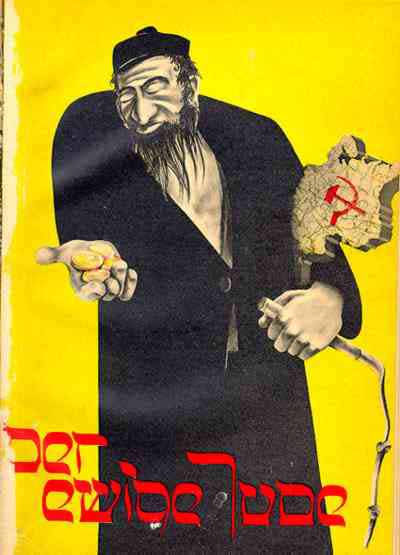
Photos from the 1937 book "The Eternal Jew" published by the Nazi Party
"... eight of the 265 photographs in a book called “The Eternal Jew,” published by the Nazi Party's publishing house in 1937. The book consists entirely of photographs with brief captions. The photos chosen generally make Jews look as unpleasant as possible."
Photos Link:Nazi Propaganda Film Classic"The Eternal Jew"(Der-Ewige-Jude)/Still Photos
Der Ewige Jude (1940) See paper by Stig Hornshoj-Moller (with links & photos)
A review essay of the film "The Eternal Jew" in a 1940 Nazi monthly for propagandists/"The Eternal Jew: The Film of a 2000-Year Rat Migration" (no author's name given). This essay is posted at the German Propaganda Archive @ http://www.calvin.edu/academic/cas/gpa/.
For an examination of the Nazi regime's use of propaganda films, see: Katie Trumpener, "Drowning out the Newsreel", London Review of Books, 12 March 2009. This article can be viewed @ http://www.arnoldleder.com/readings/index.html. Scroll to the section on "The Holocaust/Shoah" and look for the author and title of this article. This location is password protected. Password and user name for access will be provided to students in the course.
Edward Rothstein/Nazis' 'Terrible Weapon', Aimed at Minds and Hearts (w/slide show)/NYT February 23, 2009
For an example of the posters/images on display, see: http://www.nytimes.com/imagepages/2009/02/24/arts/24muse_CA0.ready.html.
For the complete slide show, see: http://www.nytimes.com/slideshow/2009/02/24/arts/design/20090224-museum-slideshow_index.html.
"The impact of these images is prerational or antirational; they short-circuit argument. To suggest that perhaps this caricatured figure was not to blame for the war would be like insisting on an alternate universe. The accusation could be rejected only if everything were rejected. Exorcism and murder were not a policy; they were a responsibility. They all flowed out of these posters and their associated beliefs.
...
Nazi propaganda was something different in kind, not just degree. It created a world that had no foundation except in myth, even attributing the Nazi desire for extermination of the Other to the Other. Nazis accused the Jews of having a secret plan to exterminate the Germans and, as evidence, ...
...
... what was so powerful about Nazi propaganda: It didn’t just distort reality to make an argument; it reshaped it. It tapped into mythic beliefs about Jews being genocidal and inhuman, thus spurring retaliation."
Readings:
Goldhagen/Hitler'sWillingExecutioners, Introduction, Chapters 1, 2, 3.
Christian Anti-Judaism in Europe
Victoria J. Barnett/The Role of the Churches: Compliance and Confrontation/Dimensions: A Journal of Holocaust Studies 1998, Vol. 12, No.2.
"Lord, I ascribe it to thy grace,
And not to chance as others do,
That I was born of Christian race,
And not a Heathen, or a Jew."
From: Isaac Watts, Divine Songs for the Use of Children Song 6: Praise for the Gospel [June 18, 1715].
For an example and some discussion of 18th century Christian hostility to Jews with a reference to the popular hymns by Isaac Watts, see:
Michael Marissen/Unsettling History of That Joyous 'Hallejuah'/Arts & Leisure Section-Music/NYT Sunday, April 08, 2007, pp. 24 & 30.
"... Messiah lovers may be surprised to learn that the work was meant not for Christmas but for Lent, and that the Hallelujah chorus was designed not to honor the birth or resurrection of Jesus but to celebrate the destruction of Jerusalem and the Second Temple in A.D. 70. For most Christians in Handel’s day, this horrible event was construed as divine retribution on Judaism for its failure to accept Jesus as God’s promised Messiah.
... To create the Messiah libretto Charles Jennens, a formidable scholar and a friend of Handel’s, compiled a series of scriptural passages adapted from the Book of Common Prayer and the King James Version of the Bible. As a traditionalist Christian, Jennens was deeply troubled by the spread of deism, the notion that God had simply created the cosmos and let it run its course without divine intervention. Christianity then as now rested on the belief that God broke into history by taking human form in Jesus. For Jennens and others, deism represented a serious menace. Deists argued that Jesus was neither the son of God nor the Messiah. Since Christian writers had habitually considered Jews the most grievous enemies of their religion, they came to suppose that deists obtained anti-Christian ammunition from rabbinical scholars. The Anglican bishop Richard Kidder, for example, claimed in his huge 1690s treatise on Jesus as the Messiah that “the deists among us, who would run down our revealed religion, are but underworkmen to the Jews.
... Jennens took his reading from Henry Hammond, the great 17th-century Anglican biblical scholar, whose extended and fiercely erudite commentary on Psalm 2 suggests the advantage of 'nations' over 'heathen: 'Nations' can readily include the Jews. In the 18th century no one would have uncritically used the King James Bible and the Book of Common Prayer’s word 'heathen' for Jews or Judaism. Even children would have known this, from the famous hymn writer Isaac Watts’s wildly popular Divine Songs for the Use of Children, which includes the verse 'Lord, I ascribe it to thy Grace, /And not to Chance, as others do, /That I was born of Christian race, /And not a Heathen or a Jew'. "
For a description of a challenge to Michael Marissen's view of Handel's "Messiah", see : James R. Oestreich/Hallelujah Indeed: Debating Handel's Anti-Semitism/Arts Section-Music/NYT April 23, 2007 p. B3.
Recommended:
Jeffrey Herf/The Jewish Enemy: Nazi Propaganda During World War II And The Holocaust (Harvard University Press 2006)
Alan E. Steinweis/Studying the Jew: Scholarly Anti-Semitism in Nazi Germany (Harvard University Press 2006)
Christopher Browning/Ordinary Men: Reserve Police Battalion 101 and the Final Solution in Poland [with new Afterword]
Ray Fisman, "The Persistence of Hate" Slate June 1, 2011
German communities that murdered Jews in the Middle Ages were more likely to support the Nazis 600 years later.
"The authors of the new study ... examine the historical roots of the virulent anti-Semitism that found expression in Nazi-era Germany. In a sense, their analysis can be seen as providing a foundation for the highly controversial thesis put forth by former Harvard professor Daniel Goldhagen in Hitler's Willing Executioners. Goldhagen argued that the German people exhibited a deeply rooted 'eliminationist' anti-Semitism that had developed over centuries, which made them ready accomplices in carrying out Hitler's Final Solution."
See immediately below for the study, "Persecution Perpetuated: The Medieval Origins of Anti-Semitic Violence in Nazi Germany", referred to in this article.
Voigtländer, Nico and Voth, Hans-Joachim, "Persecution Perpetuated: The Medieval Origins of Anti-Semitic Violence in Nazi Germany" (May 27, 2011). Available at SSRN: http://ssrn.com/abstract=1824744 (pdf 57 pages)
Abstract:
How persistent are cultural traits? This paper uses data on anti-Semitism in Germany and finds continuity at the local level over more than half a millennium. When the Black Death hit Europe in 1348-50, killing between one third and one half of the population, its cause was unknown. Many contemporaries blamed the Jews. Cities all over Germany witnessed mass killings of their Jewish population. At the same time, numerous Jewish communities were spared. We use plague pogroms as an indicator for medieval anti-Semitism. Pogroms during the Black Death are a strong and robust predictor of violence against Jews in the 1920s, and of votes for the Nazi Party. In addition, cities that saw medieval anti-Semitic violence also had higher deportation rates for Jews after 1933, were more likely to see synagogues damaged or destroyed in the Night of Broken Glass in 1938, and their inhabitants wrote more anti-Jewish letters to the editor of the Nazi newspaper Der Stürmer.
From the Introduction (p.2.):
"Germany’s persecution of Jews during the early 20 century has been a topic of intense research interest. While some have argued that it can never be rationally explained (Levi 1979), others have pointed to underlying economic and political causes (Glaeser 2005, Arendt 1994, Cohn 2007). That a deep-rooted history of anti-Semitism was ultimately responsible for a wave of hatred has been argued by Goldhagen (1996). He observed that '... the most telling evidence supporting the argument that antisemitism has fundamentally nothing to do with the actions of Jews, and … nothing to do with an antisemite’s knowledge of the real nature of Jews, is the widespread historical and contemporary appearance of antisemitism, even in its most virulent forms, where there are no Jews, and among people who have never met Jews.' Several mechanisms for the perpetuation of hatred have been emphasized, including the role of religion. Passion plays, for example, often portrayed Jews as engaged in deicide (Glassman 1975). Anti-Semitic sculptures decorated churches and private houses, and book printing distributed these images widely.2 Several tracts of Martin Luther are strongly anti-Semitic (Oberman 1984)." [boldface added]
Sources cited by the authors:
Levi, Primo, 1987. If This is a Man and The Truce. London: Abacus; Glaeser, Edward, 2005. “The Political Economy of Hatred.” Quarterly Journal of Economics; Arendt, Hannah, 1994. The Origins of Totalitarianism. Harcourt, Inc., New York; Cohn, Samuel Kline, 2007. “The Black Death and the Burning of Jews.” Past & Present 196 (1): 3-36; Glassman, Bernard, 1975. Anti-Semitic Stereotypes Without Jews: Images of the Jews in England, 1290-1700. Detroit: Wayne State University Press; Oberman, Heiko A., 1984. The Roots of Anti-Semitism in the Age of Renaissance and Reformation. Philadelphia: Fortress Press.
From the Conclusion:
"Our findings lend qualified support to theories that explain anti-Semitism based on deep cultural roots." (See footnote 52 below.) [boldface added]
Footnote 52 "Goldhagen (1996) argued that the Holocaust reflected widespread, ‘exterminationist’ anti-Semitic beliefs. We find that local precedent mattered, but this does not lend direct support to Goldhagen’s wider argument." (p. 30.) [boldface added]
"One question for future research is how common the long-term persistence of inter-ethnic hatred is. There is anecdotal evidence that it is not rare. For example, England, France, and Spain expelled their Jews during the Middle Ages. Nonetheless, anti-Semitism lingered. Until recently, Spanish children played a game called ‘Killing Jews’ around Easter – in a country where Jews have been almost entirely absent since 1492." (pp. 30-31.)
[The authors' source for the report on the game played by Spanish children is given as: Perednik, Gustavo, 2003. “Naïve Spanish Judeophobia”, Jewish Political Studies Review 15(3- 4).]
Recommended for additional general information on Anti-Semitism:
On the infamous Protocols of The Elders Of Zion, see:
http://www.ushmm.org/wlc/en/index.php?ModuleId=10007058
http://ddickerson.igc.org /protocols.html
On Anti-Semitism, see:
http://www.ushmm.org/museum /exhibit/focus/antisemitism/
http://ddickerson.igc.org/antisemitism.html
Films:
A Film Unfinished (2010)
Jud Süss ("Jew Suess" 1940)
Der Ewige Jude ("The Eternal Jew" 1940)
Return to the beginning of the syllabus
VII. The
War Against The Jews
Photo Link:
Synagogue Burns In Siegen, Germany During Kristallnacht,
The Night Of Broken Glass/November 10, 1938.
Goldhagen/Hitler's Willing Executioners, Chapter 4.
Clendinnen/Reading The Holocaust, Chapter 6.
Backgrounder on Aharon Appelfeld @ http://www.jewishvirtuallibrary.org/jsource/biography/appelfeld.html
Appelfeld/Badenheim 1939, the entire novel
On Appelfeld's Badenheim 1939
For background on vacation retreats and spas in Europe similar to the one depicted in Aharon Appelfeld's novel Badenheim 1939, see:
Natalie Naimark-Goldberg, The Haunted Spas of Europe, Tablet Magazine, February 8, 2013.
"Jews flocked to retreats like Marienbad, but what couldn’t be healed was Europe’s anti-Semitism."
Vasily Grossman, "The Old Teacher", in Robert Chandler (ed.), The Road: Stories, Journalism, and Essays (New York Review of Books Classic 2010), pp. 84-115. Read the Introduction to this book which includes biographical information on Vasily Grossman. The various writings of Vasily Grossman in this book are translated from the Russian by Robert and Elizabeth Chandler, with Olga Mukovnikova. Vasily Grossman's short story "The Old Teacher" was first published in the September and October 1943 issues of Znamya. It is "among the first works of fiction about the Shoah in any language." Robert Chandler (ed.), The Road (p. 75.). Vasily Grossman's short story, "The Old Teacher", will be provided to students.
Jewish Resistance
Edward Rothstein Resisting the Nazis Despite the Odds (includes photos)/NYT Arts Section pp. B1 & B2, April 16, 2007
"... the gradually tightening grip that held European Jews; the impressions that couldn’t fully foreshadow what was to come; the human impulse toward hope being slowly stifled. 'How does one respond,' an introductory film asks, 'when the future is unknown?' ...
'Who can you turn to?' asks the label text. 'Who will speak for you when your government turns enemy and neighbors turn away?' 'Is it better to lie low or stand tall?' And another question: 'To stay or to go?' ... When the scale of the Nazi ambition starts to become clear, it is beyond comprehension. ...
In the show’s companion book, the historian David Engel suggests that at first Jews saw the Nazi phenomenon as a recurrence of earlier traumas, as part of the cycle of Jewish historical experience. Jews, after all, had received full German citizenship only in 1871, so if they were deprived of benefits in 1933, it was more a regression than a cataclysm. ...
The sense of repetitive cycles was reinforced by the literal medievalism of German oppression: the ghettos, the yellow stars, the governing Jewish councils. These historical echoes, Mr. Engel suggests, made Jews less likely to see clearly what was happening and made resistance less likely."
Evgeny Finkel, "The Pheonix Effect of State Repression: Jewish Resistance during the Holocaust", American Political Science Review,
 109.2
(May 2015): 339-353 @ http://search.proquest.com.libproxy.txstate.edu/docview/1675033354/fulltext/EB7EEE5C94B14D04PQ/9?accountid=5683.
109.2
(May 2015): 339-353 @ http://search.proquest.com.libproxy.txstate.edu/docview/1675033354/fulltext/EB7EEE5C94B14D04PQ/9?accountid=5683.
Texas State University Library permalink. A valid User Name and password are required for access.
Recommended:
Christopher Browning/The Origins Of The Final Solution/Garners Books 2005 (Original hard cover Univ. Of Nebraska Press & Yad Vashem 2004)
Read excerpts from Browning, The Origins of the Final Solution (1939-1942)
Walter Reich/'We Are All Guilty'/NYT Sunday Book Review May 17, 2009. A review of Richard J. Evans/The Third Reich At War (The Penguin Press 2009).
"The public’s memory of what Nazi Germany was and did has been, in recent years, mangled and trivialized. Widely seen but misleading films and politicized accusations of countries perpetrating “holocausts” against various groups have debased people’s sense of the real nature of the Germans’ deeds during World War II.
...
Yet another strand is the way in which German forces — the SS but also the regular army — carried out that vision of racial reordering and extermination. Having been indoctrinated by Nazi propaganda, they murdered and brutalized Slavs and even more methodically exterminated Jews. Gypsies, too, became targets for mass murder. In the name of genetic purity they even killed their own handicapped citizens. Everything was to be done ruthlessly, pitilessly. Raw violence was at the core of who the Nazis were and what they did.
...
Evans’s central figures are, of course, the moral monsters we expect to encounter in such a history — Hitler, Himmler, Goebbels, Göring, Bormann, Heydrich, Eichmann, Rosenberg, as well as the many others who made up the Nazi elite. We also meet the monstrous German officials — propagandists, military leaders, bureaucrats and death-camp commanders — who made sure the Nazi machine did its grindingly destructive work. But Evans also introduces us to others we’ve never met — German soldiers, civilians, true believers and occasional doubters.
From reports by soldiers methodically shooting Jews at the edges of pits, as well as the boasts by German leaders about the glorious and necessary exterminations, the documentation of the gassing operations, the testimonies of witnesses and the diaries of the victims themselves, Evans gives us a dynamic sense not only of this ferocious drama’s bloody landscape but also of the characters who created, inhabited and were swallowed up by it.
If the racial reordering of Europe was the heart of the Nazi animating vision, the Holocaust was that heart’s left ventricle. Evans shows how, with the invasion of the Soviet Union, the mass murder of the Jews began. German killing squads fanned out to shoot them. One SS man who methodically murdered Jews and watched as “brains whizzed through the air” wrote: “Strange, I am completely unmoved. No pity, nothing.” Soldiers and SS men took snapshots of the executions, some of which were found in their wallets when they were killed or captured by the Red Army. (boldface added)
Eventually, this program of murdering individual Jews by shooting was replaced by a program of mass gassings. The early killing factories — Belzec, Treblinka, Sobibor — were set up primarily to exterminate Poland’s Jews. Others were added, including the largest one of all, Auschwitz-Birkenau, where many of the Jews of Western Europe, as well as Hungary, were gassed. Evans agrees with the estimate that the number of Jews murdered in the Holocaust was at least 5.5 million and probably about six million. He quotes one German Army officer whose diary we follow through the book. Wilm Hosenfeld was stationed in Warsaw and knew what was happening at nearby Treblinka. He was utterly extraordinary in his feelings of shame for what his country did. “With this terrible murder of the Jews,” Hosenfeld wrote in June 1943, “we have lost the war. We have brought upon ourselves an indelible disgrace, a curse that can never be lifted. We deserve no mercy, we are all guilty.”
Evans settles the case that the extermination of the Jews was the product of Hitler’s wishes — that he set the guidelines about the need to 'destroy, remove, annihilate, exterminate the Jews of Europe.' Himmler interpreted Hitler’s genocidal impulses, and officers on the ground put them into effect." (boldface added)
Films & Related Materials:
"The Wannsee Conference" - View this video @ https://www.youtube.com/watch?v=3ave9RHTqkI
Wannsee House/Photos
Wannsee Conference & Final Solution/Protocol/Documents America And The Holocaust (Video)/pbs.org/wgbh/amex/holocaust/
For an award winning analysis of the FDR administration and the Holocaust, see: David S. Wyman/Abandonment of the Jews: America and the Holocaust (Knopf 1984).
For a report on a book published in May, 2009 on Roosevelt and the Holocaust, see: Patricia Cohen/Roosevelt And the Jews: A Debate Rekindled/ NYT May 1, 2009.
"The book, Richard Breitman (ed.), Barbara McDonald (ed.), Severin Hochberg (ed.), Refugees and Rescue: The Diaries and Papers of James G. McDonald, 1935-1945 (Indiana University Press 2009), will undoubtedly reignite the charged debate over whether Roosevelt could have done more to rescue millions of Jews, Gypsies, gay people, dissidents and others who died in Nazi death camps. To his detractors, the refusal in June 1939 to take in any of the more than 900 Jews aboard the ocean liner St. Louis who were seeking a haven after Germany’s deadly Kristallnacht is much more emblematic of the United States’ response. Many of those passengers ultimately died."
For a critique of this book, see:
"New Evidence" on FDR's Response To The Holocaust? Not New, Not Evidence/Wyman Institute Report@www.wymaninstitute.org/fdr-evidence.php.
For the full text of the Wyman Institute report, see: "Not New, Not Evidence: An Analysis of the Claim that Refugees and Rescue Contains New Evidence of FDR's Concern for Europe's Jews" (pdf).
Nina Bernstein/After a Fight to Survive, One to Succeed (with photos)/NYT - N.Y. City & Region Section, Sunday, March 9, 2008
For related material on America and the Holocaust, see:
Patricia Cohen/In Old Files, Fading Hopes of Anne Frank's Family/NYT February 15, 2007
VIII. Ordinary Germans & The Holocaust (Police Battalion 101 And Others)
Readings:
Goldhagen/Hitler's Willing Executioners, Chapters 6, 7, 8, 9, 15, 16, and Epilogue.
Christopher Browning/Ordinary Men: Reserve Police Battalion 101 and the Final Solution in Poland (1993) [with a new Afterword]
For more information on the experiments to which Browning refers in his work, Ordinary Men, see:
The Stanford University Prison Abuse Experiment (1971) and related links.
For an analysis of Stanley Milgram's studies, referenced by Christopher Browning in his book Ordinary Germans, see:
Cari Romm, "Rethinking One of Psychology's Most Infamous Experiments", The Atlantic, January 2015 @ http://www.theatlantic.com/health/archive/2015/01/rethinking-one-of-psychologys-most-infamous-experiments/384913/
"In the 1960s, Stanley Milgram's electric-shock studies showed that people will obey even the most abhorrent of orders. But recently, researchers have begun to question his conclusions—and offer some of their own".
Cass Sunstein, "The Thin Line", The New Republic, May 21, 2007, Vol. 236, No. 4, 183, pp. 51-55.
Texas State University permalink. A valid Texas State University User Name and password are required.
Cass Sunstein's essay is a review of the book The Lucifer Effect: How Good People Can Turn Evil by Philip Zimbardo (March, 2007).
"Why do human beings commit despicable acts? One answer points to individual dispositions; another answer emphasizes situational pressures. In 2005, Secretary of State Condoleezza Rice stressed the importance of individual dispositions in describing terrorists as "simply evil people who want to kill." Situationists reject this view. They believe that horrible acts can be committed by perfectly normal people. The most extreme situationists insist that in the right circumstances, almost all of us might be led to commit atrocities. ... What emerges is a clear challenge to the most ambitious claims for situationism, and a more complicated understanding of the relationship between individual dispositions and social situations. And there is a final point. Zimbardo shows that the very assumption of a particular social role automatically conveys a great deal of information about appropriate behavior: consider the roles of nurse, first officer, and prison guard. But social roles are not fixed. Nurses and first officers need not think that they should always follow doctors and captains, and prison guards need not feel free to brutalize prisoners. Perhaps the largest lesson of Zimbardo's experiment involves the importance of ensuring that a constant sense of moral responsibility is taken to be part of, rather than inconsistent with, a wide range of social roles."
Shandley (ed.)/Unwilling Germans? The Goldhagen Debate, Introduction, Chapters 6, 7, 26.
Clendinnen/Reading The Holocaust, Chapters 7, 8.
The “Willing Executioners”/ “Ordinary Men” Debate: Daniel J Goldhagen, Christopher Browning, Leon Wieseltier-Introduction by Michael Berenbaum/April 8, 1996 (pdf) @ http://www.ushmm.org
Daniel Jonah Goldhagen, "A Reply to My Critics: Motives, Causes, and Alibis", The New Republic, December 23, 1996, pp. 37-45.
This essay may be accessed @http://libproxy.txstate.edu/login?url=http://search.ebscohost.com/login.aspx?direct=true&db=f6h&AN=9612107793&site=ehost-live&scope=site. This is a Texas State University Library permalink. A valid Texas State password and Texas State ID are required for access.
Peter Longerich/Holocaust:The Nazi Persecution and Murder of the Jews (Oxford Univerity Press, 2010)
Referring to the Goldhagen-Browning debate, Longerich sees a need for more complex explanations of the Holocaust that do not rely heavily on "situational" factors (Browning) or previous dispositions prevalent in German society (Goldhagen). He notes the tendency of recent research to examine the mindset of the individual, the individual's capacity for independent initiative, and the room for manoeuvre available to that individual. (p. 3)
Neil A. Lewis/In the Shadow of Horror, SS Guardians Frolic/NYT September 19, 2007
"... a scrapbook of sorts of the lives of Auschwitz’s senior SS officers that was maintained by Karl Höcker, the adjutant to the camp commandant. Rather than showing the men performing their death camp duties, the photos depicted, among other things, a horde of SS men singing cheerily to the accompaniment of an accordionist, Höcker lighting the camp’s Christmas tree, a cadre of young SS women frolicking (photo) and officers relaxing, some with tunics shed, for a smoking break. ...

... the comfortable daily lives of the guards with the horrific reality within the camp, where thousands were starving and 1.1 million died. ...
For example, one of the Höcker pictures, shot on July 22, 1944, shows a group of cheerful young women who worked as SS communications specialists eating bowls of fresh blueberries. One turns her bowl upside down and makes a mock frown because she has finished her portion. ...
On that day, said Judith Cohen, a historian at the Holocaust museum in Washington, 150 new prisoners arrived at the Birkenau site. Of that group, 21 men and 12 women were selected for work, the rest transported immediately to the gas chambers. ...
Höcker fled Auschwitz before the camp’s liberation. When he was captured by the British he was carrying false documents identifying him as a combat soldier. After the 1961 trial of Adolf Eichmann in Israel, West German authorities tracked down Höcker in Engershausen, his hometown, where he was working as a bank official. ...
He was convicted of war crimes and served seven years before his release in 1970, after which he was rehired by the bank. Höcker died in 2000 at 89. "
For photos from Karl Höcker's album, see: http://www.ushmm.org/research/collections/highlights/auschwitz/
Max Hastings, "The Most Evil Emperor", The New York Review of Books, October 23, 2008, Vol. 55, No. 16.
This article can be viewed @ http://www.arnoldleder.com/readings/index.html. Scroll to the section on "The Holocaust/Shoah" and look for Max Hastings: The Most Evil Emperor. This location is password protected. Password and user name for access will be provided to students in the course.
Max Hasting's essay is a review of: Mark Mazower/Hitler's Empire: How the Nazis Ruled Europe (Penguin 2008) and
Ian Kershaw/Hitler, the Germans, and the Final Solution (International Institute for Holocaust Research/Yale University Press 2008)
"So far in history no other advanced society has experienced a collapse of collective moral consciousness and individual civil morality approximating to the steepness of the decline in Germany after 1933. It was above all the absence of a choice against evil." (Kershaw, p. 230.) [boldface added]
Isabel Kershner/Women's Role in Holocaust May Exceed Old Notions (w/photos & links)/NYT Sunday, July 18, 2010
"... an American historian now living in Munich, has drawn attention to the number of seemingly ordinary German women who willingly went out to the Nazi-occupied eastern territories as part of the war effort, to areas where genocide was openly occurring. (boldface added)
... In an anomalous twist on Christopher R. Browning’s groundbreaking 1992 book, “Ordinary Men,” it appears that thousands of German women went to the eastern territories to help Germanize them, and to provide services to the local ethnic German populations there.
They included nurses, teachers and welfare workers. Women ran the storehouses of belongings taken from Jews. Local Germans were recruited to work as interpreters. Then there were the wives of regional officials, and their secretaries, some from their staffs back home.
For women from working-class families or farms in Germany, the occupied zones offered an attractive opportunity to advance themselves, Ms. Lower said.
There were up to 5,000 female guards in the concentration camps, making up about 10 percent of the personnel. Ms. Grese was hanged at the age of 21 for war crimes committed in Auschwitz and Bergen-Belsen; Ms. Koch was convicted of participating in murders at Buchenwald.
Mr. Browning’s book chronicled the role of the German Reserve Police Battalion 101, which helped provide the manpower for the elimination of most Polish Jewry within a year. The book mentions one woman, the young, pregnant bride of one of the captains of the police battalion. She had gone to Poland for a kind of honeymoon and went along with her husband to observe the clearing of a ghetto.
Only 1 or 2 percent of the perpetrators were women, according to Ms. Lower. But in many cases where genocide was taking place, German women were very close by. Several witnesses have described festive banquets near mass shooting sites in the Ukrainian forests, with German women providing refreshments for the shooting squads whose work often went on for days."
Recommended:
Gellately/BackingHitler, "Introduction", Chapter 3 "Concentration Camps & Media Reports", Chapter 6 "Injustice & the Jews", Chapter 9 "Concentration Camps in Public Spaces", and "Conclusion".
Victor Klemperer/I Will Bear Witness 1933-1941: A Diary Of The Nazi Years (Modern Library Paperback 1999)
Victor Klemperer/I Will Bear Witness 1942-1945: A Diary Of The Nazi Years (Modern Library Paperback 2001)
Michael Kimmelman/No Laughs, No Thrills, and Villains All Too Real (A comic book to teach The Holocaust in German schools w/excerpt from comic book)/NYT February 27, 2008
A new textbook shows that the Holocaust has come a long way as a topic to be freshly considered by a new generation of German teenagers.
"The other morning (in Berlin) Jens Augner, slight and owlish, a schoolteacher in his 40s, quizzed his eighth-grade class of 13- and 14-year-olds at the Humboldt Gymnasium, a local school. As part of a trial program, he has just introduced a new history textbook into the curriculum: to be exact, a comic book about the Holocaust, called The Search.
... Among other things, the book shows how far comics have come as a cultural medium taken seriously here, but also that the Holocaust has come a long way too, as a topic to be freshly considered by a new generation of German teenagers.
... With the Second World War passing from living memory, the Holocaust remains a subject taught as a singular event and obligation here, and Germans still seem to grapple almost eagerly with their own historic guilt and shame. That said, few German schoolchildren today can go home to ask their grandparents, much less their parents, what they did while Hitler was around. The end of the war is now as distant from them in time as the end of the First World War was from the Reagan presidency.
... Paradoxically, this seems to have freed young Germans — adolescent ones, anyway — to talk more openly and in new ways about Nazis and the Holocaust. Passing is the shock therapy, with its films of piled corpses, that earlier generations of schoolchildren had to endure.
... In the comic Esther recounts to her grandchildren what happened to her family, and in the process facts emerge about Hitler’s rise, about deportations and concentration camps. Without excusing anyone or spreading blame, the story, rather than focusing on Hitler and geopolitics, stresses instances where ordinary individuals — farmers, shopkeepers, soldiers, prison guards, even camp inmates — faced dilemmas, acted selfishly or ambiguously: showed themselves to be human. The medium’s intimacy and immediacy help boil down a vast subject to a few lives that young readers, and old ones too, can grasp."
Films & Related Materials:
Triumph Of The Will (video)
Review Of "Triumph Of The Will"-w/links for Leni Riefenstahl
Matt Zoller Seitz/Mother Of Gods: Leni Riefenstahl,1898-2003 /nypress.com/vol.16.issue38.2003
Charles Taylor/Ill Will/The Nation/May 07, 2007, Vol. 284, No. 18, pp. 44-49.
A review essay on Leni Riefenstahl: A Life by Jurgen-Trimborn (Faber and Faber 2007) and Leni: The Life and Work of Leni Riefenstahl by Steven Bach (Knopf 2007).
From Taylor's essay: "The most durable piece of Nazi propaganda may yet turn out to be the belief that Leni Riefenstahl is an artistic genius."
Return to the beginning of the syllabus
IX.
Goldhagen & His Critics & Defenders
Readings:
Shandley
(ed.)/Unwilling Germans? The Goldhagen Debate,
Chapters 11, 12, 15, 17, 19, 21, 22, 26, 28, 29, and
Chapter 16 by
Goldhagen, "The Failure of the Critics".
Films:
"German Citizens' Role In The Holocaust"
Image Link: Selection For Gas Chambers
Readings:
Clendinnen/Reading The Holocaust, Chapter 9, "Representing the Holocaust".
Cynthia Ozick, "Who Owns Anne Frank?" in Cynthia Ozick/Quarrel & Quandry (Alfred A. Knopf 2000), pp.74-102.
The Ozick essay on Anne Frank will be provided to students.
Alvin H. Rosenfeld: The Anne Frank We Remember/Lecture at University of California Santa Barbara, May 11, 2004 (about 1hr w/2 questions & answers - begin at 8 min. after Introduction)
Note the question concerning Cynthia Ozick's essay "Who Owns Anne Frank?" in Cynthia Ozick/Quarrel & Quandry (Alfred A. Knopf 2000), pp.74-102.
Cynthia Ozick, "The Rights of History and the Rights of Imagination", Commentary, March 1999, Vol. 107, Issue 3.
Texas State University permalink. A valid Texas State University User Name and password are required.
Recommended:
Omer Bartov/The "Jew" In Cinema: From The Golem To Don't Touch My Holocaust
Paul Celan (1920-1970), a German-speaking Jew, was Europe's most compelling postwar poet.
Excerpt From Death Fugue
Black milk of daybreak we drink it at evening
we drink it at midday and morning we drink it at night
we drink and we drink
we shovel a grave in the air there you won't lie too cramped
A man lives in the house he plays with his vipers he writes
he writes when it grows dark to Deutschland your golden hair Marguerite
he writes it and steps out of doors and the stars are all sparkling
he whistles his hounds to come close
he whistles his Jews into rows has them shovel a grave in the ground
he orders us strike up and play for the dance
Black milk of daybreak we drink you at night
we drink you at morning and midday we drink you at evening
we drink and we drink
A man lives in the house he plays with his vipers he writes
he writes when it grows dark to Deutschland your golden hair
Margeurite
your ashen hair Shulamith we shovel a grave in
the air there you won't lie too cramped
He shouts jab this earth deeper you lot there you others sing up
and play
he grabs for the rod in his belt he swings it his eyes are blue
jab your spades deeper you lot there you others play on for the
dancing
(Translated by John Felstiner)
For an excellent biography of Paul Celan,
see: John Felstiner/Paul
Celan: Poet, Survivor, Jew (Yale University Press 1995)
"... the tale of Dina Gottliebova Babbitt, who survived two years at the Auschwitz concentration camp by painting watercolor portraits for the infamous Nazi Dr. Josef Mengele.
... the colorful mural that Mrs. Babbitt painted in the children’s barracks there. She started with Walt Disney’s version of Snow White, but her audience clamored for the Seven Dwarfs as well, and some farm animals. The original mural is believed to have been destroyed, and the story uses a re-creation Mrs. Babbitt painted last year."
See the illustrated Comics for a Cause (pdf) that recounts the experience of Dina Gottliebova Babbitt at Auschwitz in World War II, and her recent efforts to reclaim her art.
Films, Music & Related Materials:
A. O. Scott/Never Forget. You're Reminded.(Review Essay on Holocaust films w/stills from film scenes, trailers, & links)/NYT Sunday Arts & Leisure Section, pp. 1& 13, November 23, 2008
Collective Tragedy Becomes a Cinematic Genre That Plays to Hearts, Minds and Awards
"The sensations associated with the Holocaust have become perhaps too easy to evoke, given the power of cinema to dispense fear, pity, sorrow and relief through sound, image and pageantry.
This has been the route taken by most English-language films about the Holocaust, and also some of their slick European counterparts ... represent another strain in European and Israeli film, one that may reflect a deeper cultural difference. In the United States the Holocaust is a mystery, a puzzle, and the obsessive interest in it testifies to its intrinsic strangeness. In France, in Germany and in Eastern Europe it remains an urgent problem that needs to be worked out — in art, in politics and in the society as a whole.
It seems right that movies about a difficult subject should themselves be difficult. But the fate of difficult movies with subtitles, usually, is to slip in and out of American theaters without leaving much of a trace. The big Holocaust movies of the big movie season will make more of an impression, allowing audiences vicarious immersion in a history that they nonetheless keep at a safe, mediated difference, even as they risk bathos and overreach in the process. We don’t have to ask what the Holocaust means to us since the movies answer that question for us.
For American audiences a
Holocaust movie is now more or less equivalent to a western or
a combat picture or a sword-and-sandals epic — part of a genre
that has less to do with history than with the perceived
expectations of moviegoers. This may be the only, or at least
the most widely available, way of keeping the past alive in
memory, but it is also a kind of forgetting." (boldface added)
Schindler's List
(1993) [3 hrs. & 17 min.]
The Holocaust film which likely has been
viewed by more people than any other Holocaust film.
Ruth Franklin/Unlikely Savior/NYT Sunday Book Review November 02, 2008.
The Road to Rescue: The Untold Story of Schindler's List by Mietek Pemper and Searching for Schindler: A memoir by Thomas Keneally, pay tribute to Oskar Schindler and the “multifarious acts of resistance” that made his rescues possible.
Read the first chapter of each of these books:
The Road to Rescue by Mietek Pemper - 1st chapter.
Searching for Schindler by Thomas Keneally - 1st chapter.
Readings:
In Loshitzky (ed.)/Spielberg's Holocaust, these articles:
Loshitsky, "Introduction"
Bartov, "Spielberg's Oskar: Hollywood Tries Evil"
Horowitz, "But Is It Good for the Jews?..."
Doneson, "The Femininization of the Jew"
Weissberg, "The Tale of a Good German"
Cheyette, "The Uncertainty of Schindler's List"
Films:
The Pianist
For a critical view of this award winning
film see: Michael B. Oren, "Schindler's Liszt",
The New Republic
, March 17, 2003, Vol. 228, Issue 10.
Texas State University
permalink. A valid Texas State University User Name
and password are required.
Jacob The Liar
Return to the beginning of the syllabus
XI. Anti-Semitism Past & PresentFact Sheet on the Elements of Anti-Semitic
Discourse: Common Motifs & Markers for Anti-Semitism, The
Louis D. Brandeis Center for Human Rights Under Law @ http://brandeiscenter.com/publications/factsheets
(pdf) Scroll to the Fact Sheet on The Elements of Anti-Semitic
Discourse.
Institute
for the Study of Contemporary Antisemitism -
Indiana UniversityLinks to various resources, scholarly materials, lectures, and news of events and developments.
Film:
"European Antisemitism from Its Origins to the Holocaust" (13 minutes) United States Holocaust Memorial Museum @ https://www.ushmm.org/confront-antisemitism/european-antisemitism-from-its-origins-to-the-holocaust
An introduction to the history of antisemitism from the days of the early Christian church until the era of the Holocaust in the mid-20th century.
Readings:
Ruth R. Wisse, "The Functions of Anti-Semitism", National Affairs, Number 33, Fall 2017
@ https://nationalaffairs.com/publications/detail/the-functions-of-anti-semitism
"The study of anti-Semitism properly belongs to the study of politics, though it has rarely been taken up this way.
...
Politics organized against the Jews has been practiced, at one time or another, in every Western society and throughout the Middle East for more than a century. This organizing principle has been adapted to the purposes of communism, fascism, pan-Arab nationalism, and progressivism, and it has persisted as an anti-liberal force that appeals to extremists on the right and the left. Not in the name of special pleading on behalf of the Jews, its proximate target, or the liberal order, its larger enemy, but even simply because anti-Jewish politics is such an enduring and ubiquitous force, and because it has not yet been adequately studied as a political strategy, it is time for scholars of political and social life to bring to it the same urgency and rigor they have brought to virtually every other meaningful political phenomenon. That is what real awareness would require."
Cynthia Ozick,The Modern 'Hep! Hep! Hep!' | Observer @ observer.com/2004/05/the-modern-hep-hep-hep/
Bernard Lewis, "The New Anti-Semitism", The American Scholar,Winter 2006 Vol. 75 No. 1, pp. 25-36 @ http://libproxy.txstate.edu/login?url=http://search.ebscohost.com/login.aspx?direct=true&db=f5h&AN=19123876&site=ehost-live. Texas State University permalink. A valid Texas State University User Name and password are required.
Bernard Harrison/The Resurgence Of Anti-Semitism: Jews, Israel, And Liberal Opinion (Rowman & Littlefield 2006) (This book is highly recommended.)
"... certain words like 'Democracy' are surrounded, as it were, by an aura of positive emotional connotation for a majority of hearers. This feature gives such words a certain value when it comes to securing agreement in a political debate. The thought is, that if one can convince one's hearers that the policy one is proposing is the 'democratic' one, while one's opponent's policies are 'undemocratic', that in itself will give one an edge in debate. That gives one a motive for bringing the word democracy over to one's side in the argument, as it were, by subtly shifting its descriptive content and reference ('persuasively redefining' it) while leaving its emotional aura unchanged. Something like this is happening in the debates we have been investigating with the word holocaust. ... The thought is: 'Why should the Jews have sole use of this wonderful word, which draws so much sympathy, and money, to them. Why shouldn't we - my people, me and my political friends - have the use of it too?' It is this impulse which leads to the kind of attempt we have been witnessing to broaden the use of the term, to make the term more 'inclusive,' first by making it synonymous with 'genocide,' then by broadening its reference further to cover any massacre, then still further, ... to cover such phenomena as famines, or slavery. There is in all of these attempts at persuasive redefinition, ... a slight but perceptible edge of anti-Semitism, the sense that having established, as it seems to the objectors, sole ownership over the word holocaust, those wretched conspirators 'the Jews' have once again 'gotten away with something,' stolen other people's light, used their sufferings, real as those may be, to cast into the shade the sufferings of others." (boldface added)
... The slight edge of anti-Semitism I'm talking about is ... a subtext, something haunting ... the margins of discourse. ... there is implicit in the observance of Holocaust Day (the reference here is to the UK), as it stands, a tacit assumption that the life of of a Jew, the sufferings of a Jew, are 'worth more' than the lives and sufferings of others.
... there is no good and much harm, to be done by, in effect, redefining the term holocaust in such a way as to allow the concrete specificity of the Nazi genocide, and with it everything which links it to enduring aspects of European culture and politics, to fade from view. For that is what would happen if we were to allow ourselves to be led, through a persuasive reassignment of the descriptive content and reference of the term holocaust in the direction of greater generality, to imagine that every great evil done by human beings to one another from slavery to intertribal massacre ... is a phenomenon of exactly the same kind as the Nazi Holocaust. Everything is what it is and not another thing. Evil is not a single recurrent feature of human life, eternally self-identical in its nature. There are many kinds of evil, springing from many different causes, some of them sui generis. If we are to think rationally about these matters, if our response to human evil is not to be reduced to futile and sentimental hand wringing, we need a vocabulary which allows us to keep track of the differences." (These remarks are from Bernard Harrison, The Resurgence Of Anti-Semitism: Jews, Israel, And Liberal Opinion, Chapter 6 "Fascism and the Idea of Total War", pp. 124-126. To view the complete text of Bernard Harrison's remarks and more, see Excerpts from Bernard Harrison's book. On this site, enter a phrase in the search option {labeled "Search in this book"} such as "sole use of this wonderful word" [p.124] or "once again gotten away with something" [p.125]. Then click on the page number that appears immediately below.)
*Note: In this section of his book, Bernard Harrison acknowledges his intellectual debt to the philosopher C. L. Stevenson whose book Ethics and Language (Yale University Press, 1944), especially its material on "persuasive definition", provided the basis for Harrison's discussion of the term holocaust. (Stevenson was Harrison's teacher.)
This is a brief excerpt from a 1938 article by C. L. Stevenson on persuasive definitions. See also these brief excerpts from Chapter VI (persuasion) and Chapter XIII (function of definitions) of C. L. Stevenson's book Ethics and Language.
Excerpts from Bernard Harrison's book (pdf)
Excerpts of reviews of Harrison book @ publisher's website
Robert S. Wistrich/A Lethal Obsession: Anti-Semitism from Antiquity to the Global Jihad (Random House 2010) - [Click on "Read an Excerpt" for pp 79 - 85 of Chapter One From Decide to Genocide]
Anthony Julius/Trials of the Diaspora: A History of Anti-Semitism in England (Oxford University Press 2010)
Walter Laqueur/The Changing Face of Anti-Semitism: From Ancient Times to the Present Day (Oxford University Press 2006)
Mark Goldblatt/The Longest Hatred (review of Laqueur book on anti-Semitism)/Claremont Institute-Writings March 08, 2007
Alvin Rosenfeld - "'Progressive' Jewish Thought and the New Anti-Semitism."/American Jewish Committee December 2006 [PDF]
Alvin Rosenfeld's essay has been much discussed from a number of different perspectives. Links to the views and works of many of the figures in the debate can be found @
http://www.keshertalk.com/archives/2007/02/rosenfeldtnr.php. Comments on this blog or on sites and works to which this blog links do not necessarily reflect the views of the instructor for this course.
U. S. Department of State Report on Contemporary Global Anti-Semitism: 2008
Anti-Semitism Worldwide/Stephen Roth Institute/Tel Aviv University
John Rosenthal, "Anti-Semitism & Ethnicity In Europe", Policy Review, October-November 2003.
Robert S. Wistrich, "Cruel Britannia", Azure, Summer 2005.
Joseph Dan, "Jewish Sovereignty as a Theological Problem", Azure, Winter 2004.
Mark Lilla, "The End of Politics: Europe, the nation-state, and the Jews", The New Republic, June 23, 2003, Vol. 228 Issue 24, p29, 5p.
Texas State University permalink. A valid Texas State University User Name and password are required.
Bret Stephens, "Against Weakness", Commentary, September, 2007, Vol. 124, Issue 2. A review of: Ruth R. Wisse, Jews and Power (Nextbook/Schocken 2007).
Texas State University permalink to this article by Bret Stephens. A valid Texas State University User Name and password are required.
Anthony Julius/A People and a Nation/NYT Sunday Book Review September 02, 2007 - review of: Ruth R. Wisse/Jews and Power (Nextbook/Schocken 2007).
Ruth R. Wisse/Jews and Power - excerpt from the book.
Yoram Hazony, " Israel Through European Eyes", Jerusalem Letters, July 14, 2010.
Eve Garrard, "The pleasures of antisemitism", Fathom, April 26, 2013 @ http://fathomjournal.org/the-pleasures-of-antisemitism/.
"... as Tolstoy and others have noticed, we often hate people in proportion to the injustices which we have done them. It's very hard for Europe to forgive the Jews for the Holocaust, ..."
Ben Cohen,"How Anti-Semitism Became a Social Movement", Mosaic October 20, 2014 @ http://mosaicmagazine.com/response/2014/10/how-anti-semitism-became-a-european-social-movement/.
Kenneth Walzer, "Reflections on Contemporary Anti-Semitism in Europe", Fathom, Summer 2015 @ http://fathomjournal.org/reflections-on-contemporary-anti-semitism-in-europe/.
Godwin's Law (Source: Wikipedia)
Paraphrased from source: Godwin's law asserts that as an online discussion goes on long enough, (regardless of topic or scope) sooner or later someone will compare someone or something to Hitler or Nazism.
Promulgated by American attorney and author Mike Godwin in 1990, Godwin's law originally referred specifically to Usenet newsgroup discussions. It is now applied to any threaded online discussion, such as Internet forums, chat rooms, and comment threads, as well as to speeches, articles, and other rhetoric where reductio ad Hitlerum occurs.
In 2012, "Godwin's law" became an entry in the third edition of the Oxford English Dictionary.
Minimizing the Jewish Connection to Jerusalem
Edward Rothstein, "Jerusalem Syndrome at the Met", Mosaic Magazine, February 2017 @ https://mosaicmagazine.com/essay/2017/02/jerusalem-syndrome-at-the-met/.
"An exhibition on the diverse multiculturalism of medieval Jerusalem has been ecstatically received. There’s just one problem: the vision of history it promotes is a myth.
...
The show’s refusal to confront history in any serious way; the failure to find artifacts that match its multicultural thesis; the depiction of the Jewish presence in Jerusalem as an “absence”—all of these contribute to the impression that, for the organizers of this exhibition, the undeniable facts of ancient Jewish history were the very things that could never be acknowledged. (As, in an opposite way, were the undeniable facts of medieval Islamic history.) Better by far to imagine Jerusalem in this fantasy as an international city without a hint of historical Jewish sovereignty, and a mythical place in which all faiths enjoyed equivalent standing". (boldface added)
See also Robert Irwin's response to Edward Rothstein's essay "Jerusalem Syndrome at the Met", February 6, 2017 (The link to Edward Rothstein's essay is located immediately above.)
"The Met’s presentation of Jerusalem as a vibrant trade hub and cultural melting pot is seductive, but false". (boldface added)
******************************
Return
to
the beginning of the syllabus
United States Holocaust Memorial Museum
http://www.jewishvirtuallibrary.org/jsource/holo.html
A Teacher's Guide to the Holocaust
Anti-Defamation League (ADL)
David S. Wyman Institute For Holocaust Studies
Documentary Resources on the Nazi Genocide and its DenialEducation...A Legacy Forum for Teachers
Imperial War Museum London -- The Holocaust Exhibition
The International Baccalaureate Holocaust Project
The Jewish Foundation for the Righteous
Resources for
Children of Holocaust Survivors
Women and the Holocaust
******************************
Return to the beginning of the syllabus
Learning and teaching take place best in an atmosphere of intellectual freedom and openness. All members of the academic community are responsible for supporting freedom and openness through rigorous personal standards of honesty and fairness. Plagiarism and other forms of academic dishonesty undermine the very purpose of the university and diminish the value of an education.
Academic Offenses
Students who have committed academic dishonesty, which includes cheating on an examination or other academic work to be submitted, plagiarism, collusion, or abuse of resource materials, are subject to disciplinary action.
a. Academic work means the preparation of an essay, thesis, report, problem assignments, or other projects which are to be submitted for purposes of grade determination.
b. Cheating means:
1. Copying from another student?s test paper, laboratory report, other report or computer files, data listing, and/or programs.
2. Using materials during a test unauthorized by person giving test.
3. Collaborating, without authorization, with another person during an examination or in preparing academic work.
4. Knowingly, and without authorization, using, buying, selling, stealing, transporting, soliciting, copying, or possessing, in whole or part, the content of an unaministered test.
5. Substituting for another student?or permitting another person to substitute for oneself in taking an exam or preparing academic work.
6. Bribing another person to obtain an unadministered test or information about an unadministered test.
c. Plagiarism means the appropriation of another's work and the unacknowledged incorporation of that work in one's own written work offered for credit. (Emphasis Added)
d. Collusion means the unauthorized collaboration with another person in preparing written work offered for credit.
e. Abuse of resource materials means the mutilation, destruction, concealment, theft or alteration of materials provided to assist students in the mastery of course materials.
Penalties for Academic Dishonesty
Students who have committeed academic dishonesty may be subject to:
a. Academic penalty including one or more of the following when not inconsistent:
1. A requirement to perform additional academic work not required of other students in the course;
2. Required to withdraw from the course with a grade of F. (Emphasis Added)
3. A reduction to any level grade in the course, or on the exam or other academic work affected by the academic dishonesty.
b. Disciplinary penalty including any penalty which may be imposed in a student disciplinary hearing pursuant to this Code of Conduct.
*************************************************************